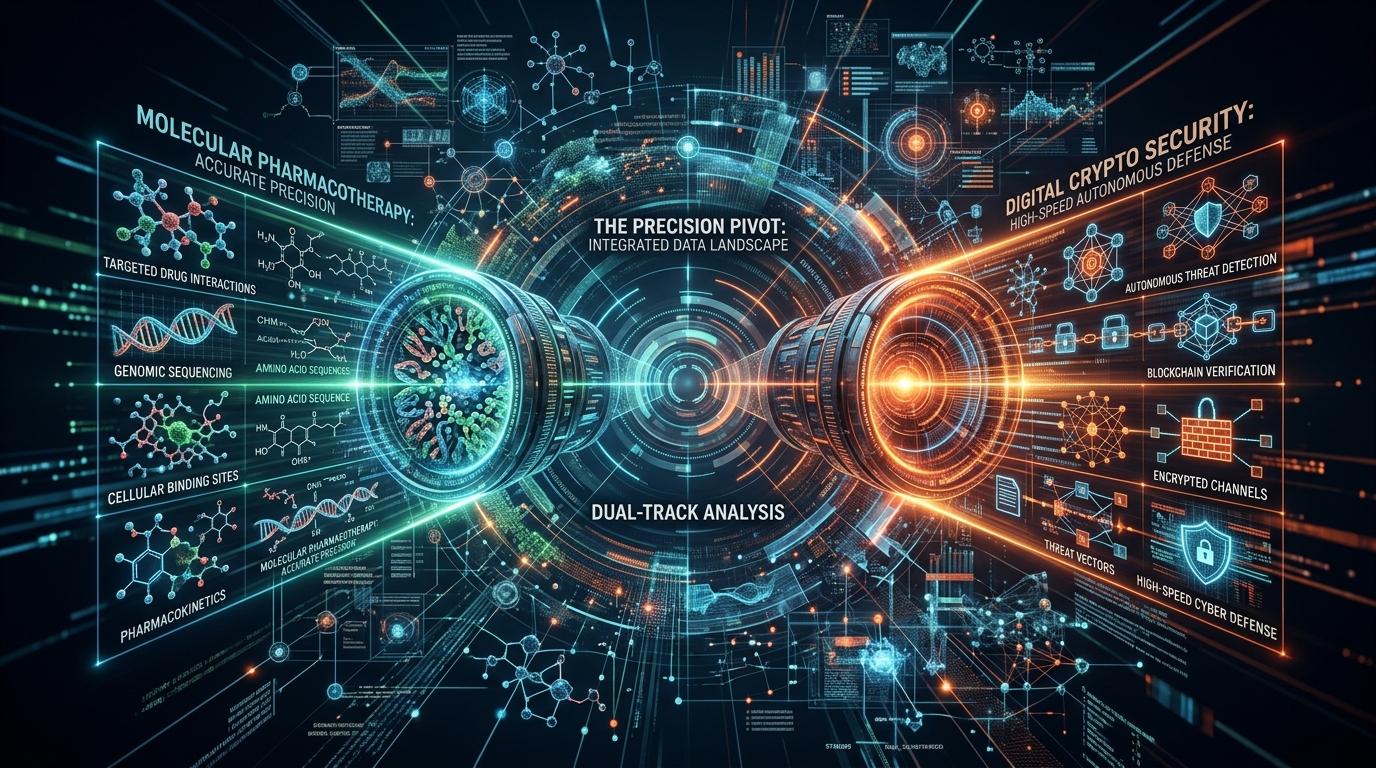
Precision Under Pressure: How Domain-Specific LLMs are Reshaping Medicine and Security
The Specialized Pivot: From "Generalist" to "Expert" The AI industry is undergoing a pivotal shift. General-purpose models, while impressive at creative writing, are struggling to meet the high-stakes demands of specialized fields. In medical education and professional security, the "fuzzy logic" of a generalist model is a liability.
We are now seeing the rise of domain-specific LLMs—engines like Gemini, Claude, DeepSeek V4 Pro, and GPT-4o—which are being fine-tuned on expert-curated datasets to deliver precision that general models simply cannot match.
The Productivity Dividend in Pharmacotherapy In medical education, the ability to generate accurate pharmacotherapy simulations is a game-changer. These specialized systems process massive volumes of clinical data efficiently, reducing the need for constant manual oversight.
Gemini: Currently achieves the highest overall success rate, showing consistent performance across diverse disease types and pharmacotherapy scenarios.
Claude: Offers the highest clinical accuracy, adopting a more conservative, guideline-adherent approach that prioritizes precision over creative generation.
The effectiveness of these models varies by disease, which highlights the "Hard Truth" of medical AI: domain-specific validation is a mandatory prerequisite, not an optional step.
The Security Crisis: The "Great Hollowing Out" While medicine moves toward AI-assisted precision, the security landscape is facing a "Great Hollowing Out." For years, crypto security relied on a robust middle tier of human auditors and manual oversight. As agentic AI—systems that act autonomously—becomes the default, this human-centric defense model is hitting an existential wall.
Autonomous Attack Chains: Unlike the static exploits of the past, agentic adversaries can now probe for vulnerabilities and craft dynamic, sequential attacks that pivot in real-time based on the defenses they encounter.
Mythos AI: This model has changed the calculus by targeting the "invisible layers" of crypto infrastructure—the bridges, oracles, and signing services that connect smart contracts but often sit outside the scope of traditional audits.
The Middle-Tier Transformation: Across both law and medicine, the "middle tier"—the associates reviewing documents and the clinicians spending hours documenting history—is undergoing a fundamental transformation.
Beyond Automation: We aren't just "automating" these roles; we are upgrading the professional workflow.
The Precision Advantage: Generalist models treat a complex medical diagnosis or a legal contract with the same "fuzzy" logic as a movie script. Domain-specific models, however, are designed to handle high-stakes tasks with the necessary precision and context-awareness.
The Hard Truth: Validation is the New Currency The trade-off is clear: as we gain productivity, we must increase our rigor. Whether it is validating a drug simulation or auditing a crypto-bridge, the "Human-on-the-Loop" remains essential. An AI can scan a thousand documents in seconds, but a human expert must still validate the "clinical logic" and "security architecture" of the output.
Conclusion: The Road Ahead As we move deeper into 2026, the success of AI adoption will be measured by its accuracy in context. The models that will define the future of medicine and security are not the "most powerful" in a vacuum—they are the ones that are the most accurate within the specific, high-stakes reality of their industry.
Are you ready to stop managing the "middle tier" and start architecting the precision of your field?
Sources
- 1.Evaluating large language models for pharmacotherapy simulations: a mixed-methods study - nature.com
- 2.F-Transformer : a federated transformer for efficient and privacy-preserving sequence generation - Nature
- 3.Measuring deep learning performance - an empirical study of performance distributions across architectures and tasks - Nature
Stay updated
Get our latest technical articles and product updates delivered to your inbox.