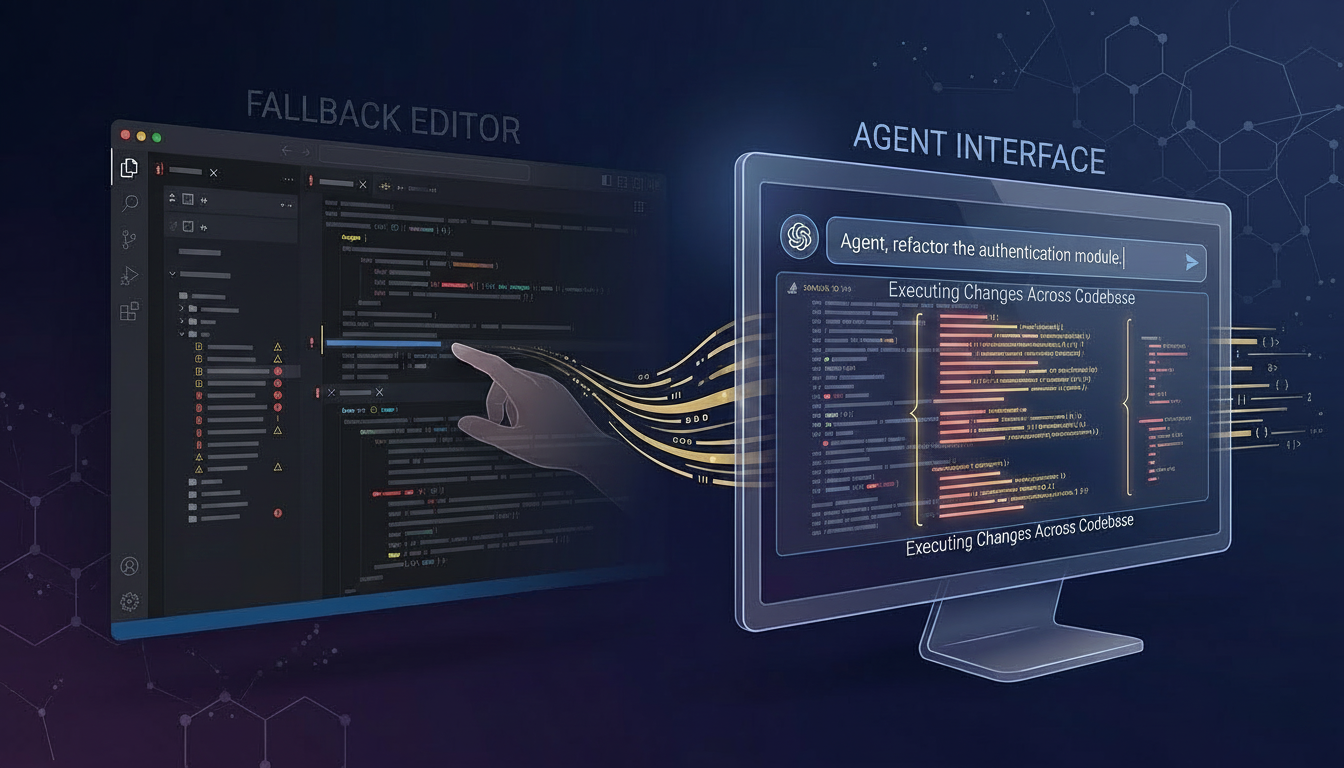
The IDE is Now a Fallback: Why We’re Moving from Writing Code to Managing Agents
For decades, the Integrated Development Environment (IDE) was the cockpit. It was the place where we spent 90% of our cognitive energy—fighting syntax errors, navigating nested file trees, and manually refactoring logic. We measured productivity by "lines of code" or "sprint velocity." But a quiet, radical inversion is happening.
With the release of Cursor 3 and the rise of truly agentic infrastructure, the IDE is being demoted. It’s no longer the primary workspace where the work happens; it’s becoming the fallback for when the AI hits a wall.
The shift introduced by Cursor 3 isn't just another autocomplete feature or a "Chat GPT in a side panel." It’s a fundamental change in how we interact with a codebase. Traditionally, a developer had to hold a mental map of the entire architecture just to find the right file to edit. You spent more time "searching" than "coding."
Cursor 3 effectively demotes the traditional editor by placing an agentic layer between the human and the raw code. You don’t browse folders anymore; you give the agent a high-level intent, and it orchestrates the changes across multiple files simultaneously. In this model, the editor becomes a verification tool. You’re there to review the diffs, not to type the characters. We’re moving from being pilots to being air traffic controllers.
One of the biggest hurdles in large-scale engineering isn't writing new code—it's understanding the old stuff. At Meta, they’ve recently shared how they face the massive challenge of mapping "tribal knowledge" within their data pipelines. For years, the context behind why a specific data flow was built a certain way lived only in the heads of senior engineers or was buried in stale documentation that nobody read.
By using AI to crawl and map these relationships, they’ve turned undocumented expertise into searchable, actionable metadata. This is the "AI Layer" in action. It’s not just generating a function; it’s providing the context that usually takes a new hire six months to acquire. When your tools understand the "why" behind the code, the need to manually dig through the IDE to understand dependencies vanishes.
This evolution isn't happening in a vacuum. It’s supported by a massive shift in how we think about servers and compute. As Fireworks AI CEO Lin Qiao recently pointed out, the demand for AI infrastructure is exploding because we are moving beyond simple models to complex agentic workflows. We are building systems that don't just "predict the next token" but "perform the next action."
At AmgapTech, we see this as the final piece of the puzzle. If the infrastructure can handle the heavy lifting of inference and the agent can handle the code orchestration, the "bottleneck" is no longer the developer's typing speed—it's the clarity of their instructions. We are shifting from a world of "resource management" to a world of "intent management."
Here is the technical caveat we have to be honest about: as the IDE becomes a fallback, the barrier to entry for "writing code" drops, but the requirement for "system thinking" skyrockets.
If you rely on an agent to write 1,000 lines of code across ten files, you must understand the architectural implications of those changes. When things break—and they will—the "fallback" IDE won't save you if you don't know the fundamentals of the system you're supposedly managing. The risk is that we produce a generation of developers who can prompt but can't troubleshoot. The "safety net" only works if you know how to land.
We are entering an era where software is no longer "operated" by developers; it works on their behalf. The IDE is becoming a safety net for edge cases, while the primary development happens at the intent level.
At AmgapTech, we’re leaning into this. We’re not just building for developers who want to write code—we’re building for engineers who want to ship outcomes. The era of the dashboard and the manual file tree is ending. The era of the agentic layer has begun. The products that win this decade won't be the ones with the most features, but the ones that require the least amount of "manual labor" to maintain.
Sources
Stay updated
Get our latest technical articles and product updates delivered to your inbox.