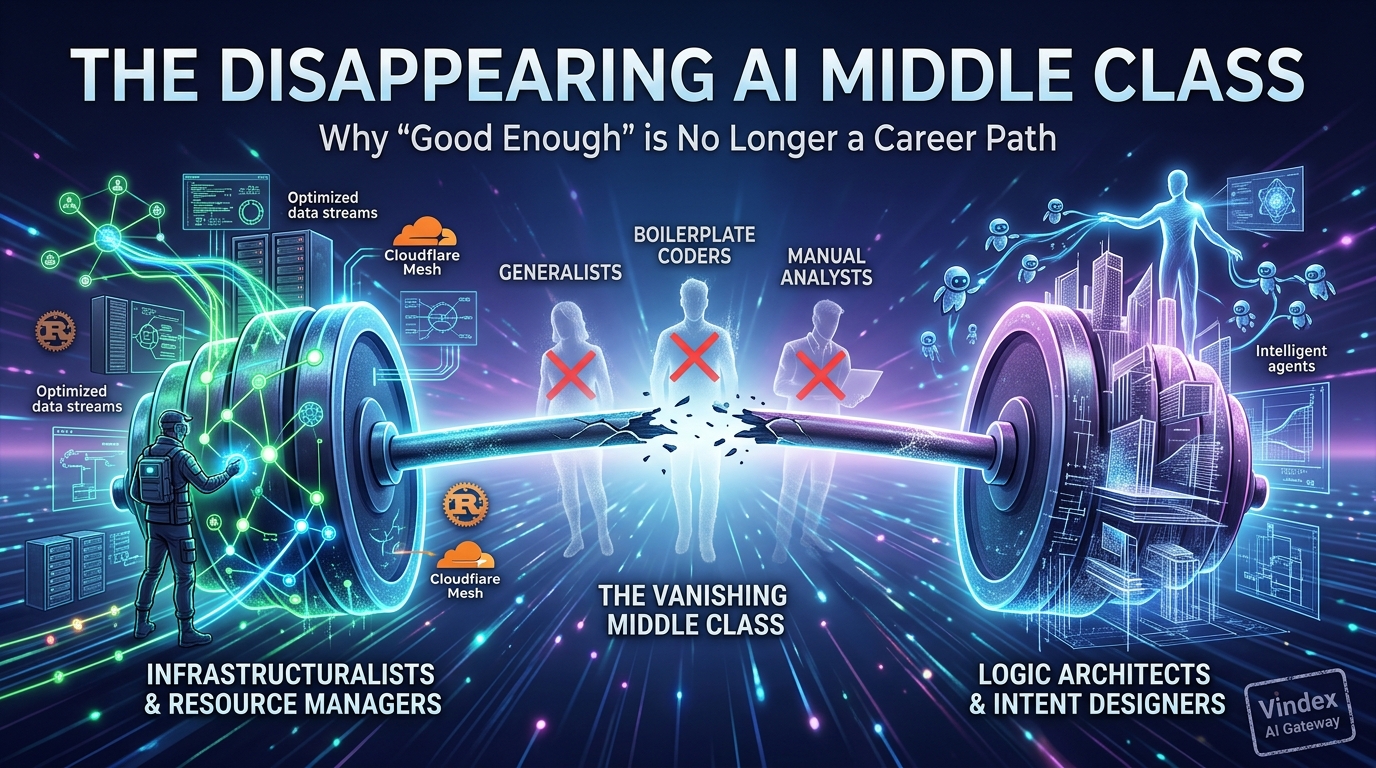
The Disappearing AI Middle Class: Why "Good Enough" is No Longer a Career Path
For decades, the tech industry thrived on a robust "middle class"—the developers who spent their days writing boilerplate, the analysts who manually summarized reports, and the mid-level managers who coordinated them. But as agentic AI—systems that don't just "chat" but actually act—becomes the default, this middle tier is facing an existential crisis.
The trend is clear: we are moving away from a world of "human-in-the-loop" to a world of "human-on-the-loop." When Amazon doubles down on its Machine Controller Platform (MCP) to automate operational tasks, it isn't just seeking efficiency; it's removing the need for the human bridge between a problem and a solution. This is the disappearing AI middle class.
One of the primary drivers of this shift is the "Performance vs. Constraint" trade-off. As highlighted in Forbes, we've learned that the more "thinking tokens" a model uses, the better the output. But "thinking" is expensive.
We are seeing a massive capacity crunch. As companies rush to deploy agents, they hit a wall of infrastructure constraints. This has created a new hierarchy:
The High-End: Organizations that can afford massive inference costs for high-reasoning models.
The Low-End: Companies using "thin" models for basic tasks.
The Dead Zone: The middle class of companies and professionals who are too slow to be automated but too expensive to be "frontier."
In this new landscape, "coding" is no longer the primary skill. Infrastructure orchestration is.
We see this with the rise of solutions like Cloudflare Mesh. In the age of agents, a traditional VPN is a bottleneck. Agents need private, high-speed, low-latency networks to communicate with each other and with secure data silos. Building an AI-powered document search isn't just about the RAG (Retrieval-Augmented Generation) logic anymore; it's about managing the ChromaDB instances, the memory synchronization, and the secure tunnels they run through.
The "Architect" of 2026 must be as comfortable with network topology as they are with prompt engineering.
As models grow in complexity, the "glue code" that holds them together can no longer be slow. This is why we at Vindex AI, along with much of the industry, are pivoting toward Rust.
[Image comparing Rust and C++ memory management models]
In a world where an agentic loop might run 10,000 times a second, the safety and performance overhead of C++ or Python is becoming a liability. Rust offers a "zero-cost abstraction" that ensures our infrastructure is both lightning-fast and memory-safe. If your agent is managing your private network, you cannot afford a memory leak.
The career path for the AI professional has split. The generalist—the person who knows "a bit of everything"—is being replaced by the specialist:
The Logic Architect: Those who can design the high-level "intent" that agents follow.
The Resource Manager: Those who can optimize models to run within the strict bottlenecks of modern hardware.
As businesses move toward usage-based pricing, every token has a dollar value. The new AI engineer is part developer, part accountant, and part systems architect.
The technical trade-off of the next two years is speed vs. sovereignty. You can use a cloud-based agentic platform and lose control of your data and costs, or you can build your own local infrastructure and take on the massive burden of orchestration.
The "Hard Truth" is that the middle ground is disappearing. If you aren't building the infrastructure or designing the high-level reasoning, the agent is already learning how to do your job.
At Vindex AI, we aren't just watching this shift; we are building the tools to survive it. The "AI Middle Class" might be vanishing, but for those who can bridge the gap between complex logic and high-performance infrastructure, the opportunities have never been greater.
The future doesn't belong to those who use AI. It belongs to those who orchestrate it.
Are you building the agent, or is the agent building you?
Sources
Stay updated
Get our latest technical articles and product updates delivered to your inbox.