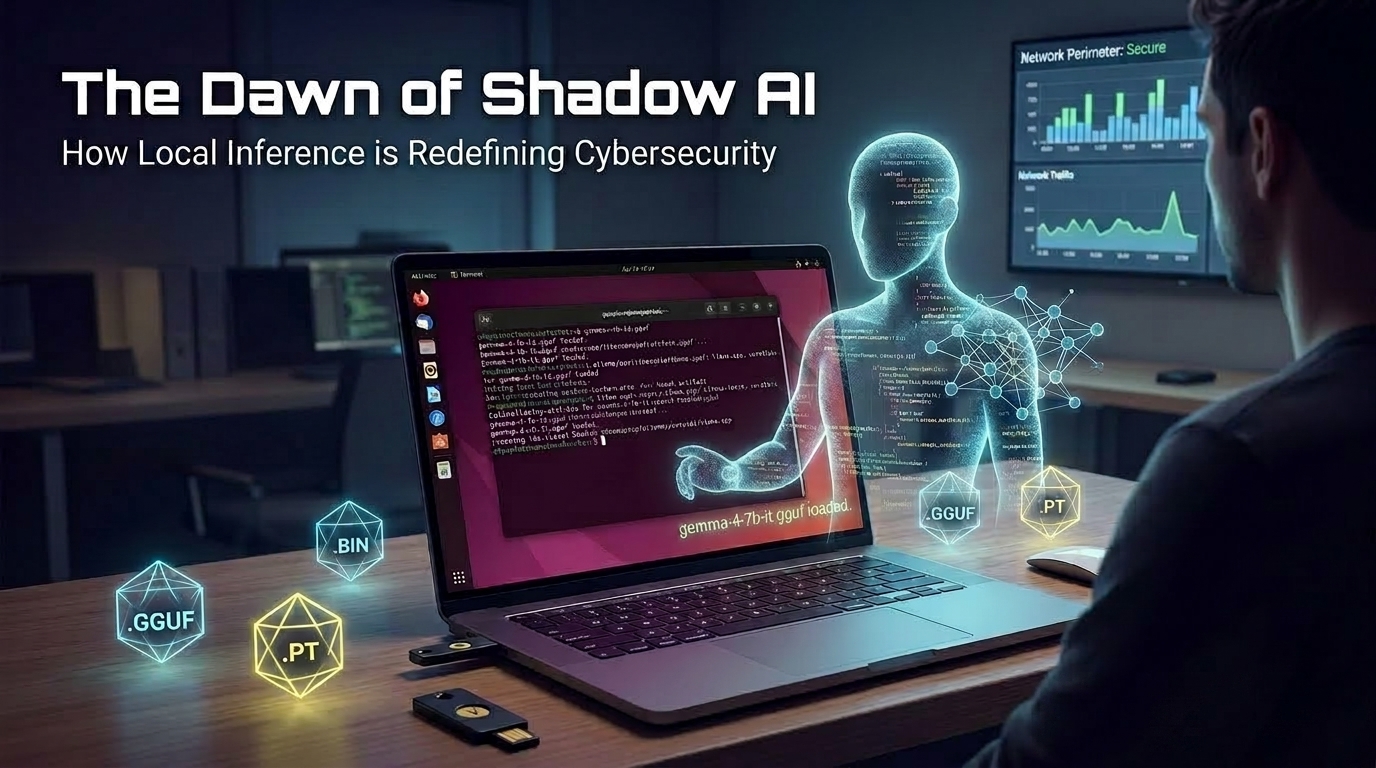
The Dawn of Shadow AI: How Local Inference is Redefining Cybersecurity
When people first talked about "Shadow AI," they meant an employee secretly using a corporate credit card for a Midjourney subscription. That was Shadow AI 1.0.
Shadow AI 2.0 is much harder to track. It’s the "Bring Your Own Model" (BYOM) era. Your developers aren't just using external tools; they are running Large Language Models (LLMs) locally on their workstations. When inference happens entirely on-device, traditional Data Loss Prevention (DLP) tools—which are designed to watch network traffic for sensitive "leaks"—become effectively blind. The data never leaves the machine, but the risk has never been higher.
Two years ago, running a useful LLM on a work laptop was a niche stunt for researchers. Today, thanks to hardware acceleration in chips like the M-series or high-end Intel i7s, and the release of highly optimized models like Google’s Gemma 4, it’s routine.
Developers are demanding this for a reason: zero latency, offline capability, and a perceived "privacy bubble." But for a company, this creates a massive Provenance Risk. If a developer uses an unvetted local model to generate production code or handle customer data, the company can no longer prove the integrity of its software supply chain during M&A diligence or litigation.
The challenge isn't just about data going out; it's about what’s happening inside the device.
DLP Blind Spots: If I process a sensitive database schema through a local instance of Llama 3 to generate a migration, my company’s security team has no record that the interaction even occurred.
Model Supply Chain Exposure: Local inference requires a whole new toolchain—downloaders, converters (like
.ggufor.ptfiles), runtimes, and Python packages. Each of these is a potential entry point for a supply chain attack that traditional antivirus software might not catch.
If you've noticed unexplained storage consumption on developer machines, you’re likely seeing the footprints of Shadow AI. Large model artifacts—often several gigabytes each—are appearing on endpoints without documentation. These files aren't just "bloat"; they are powerful engines. Without governance, a company cannot know if those models were trained on proprietary data or if they contain malicious "backdoors" designed to trigger under specific conditions.
Here is the technical trade-off: Visibility costs agility. If a CISO locks down a machine so tightly that a developer can’t run Gemma 4, that developer will find a workaround or leave for a more flexible firm. The "Hard Truth" is that on-device inference is a competitive advantage for developers. You can't stop the trend, so you must manage the artifacts.
At AmgapTech, we believe the path forward is Artifact Management. Treat AI models like you treat Docker images or NPM packages:
Vetting: Only run models from trusted registries.
Monitoring: Use endpoint detection that looks for the execution of local inference runtimes.
Policy: Clear guidelines on what data is "local-safe" versus "vault-only."
We are moving from a world of "cloud-first" AI to a hybrid reality. While frontier models like Claude Opus 4.7 will always lead in raw reasoning power for complex tasks, the "day-to-day" work of engineering is moving to the edge.
The Dawn of Shadow AI doesn't have to be a security nightmare. It’s an opportunity to build more resilient, private, and efficient systems—but only if we stop pretending that the "network perimeter" is still where the battle is won.
Is your security team watching the cloud while the models are running on the desks?
Sources
- 1.Your developers are already running AI locally: Why on-device inference is the CISO’s new blind spot - VentureBeat
- 2.How Google’s 2.3B Gemma 4 Model Rivals 70B Giants on Just 1.5GB of RAM - Geeky Gadgets
- 3.Anthropic releases Claude Opus 4.7, narrowly retaking lead for most powerful generally available LLM - VentureBeat
Stay updated
Get our latest technical articles and product updates delivered to your inbox.