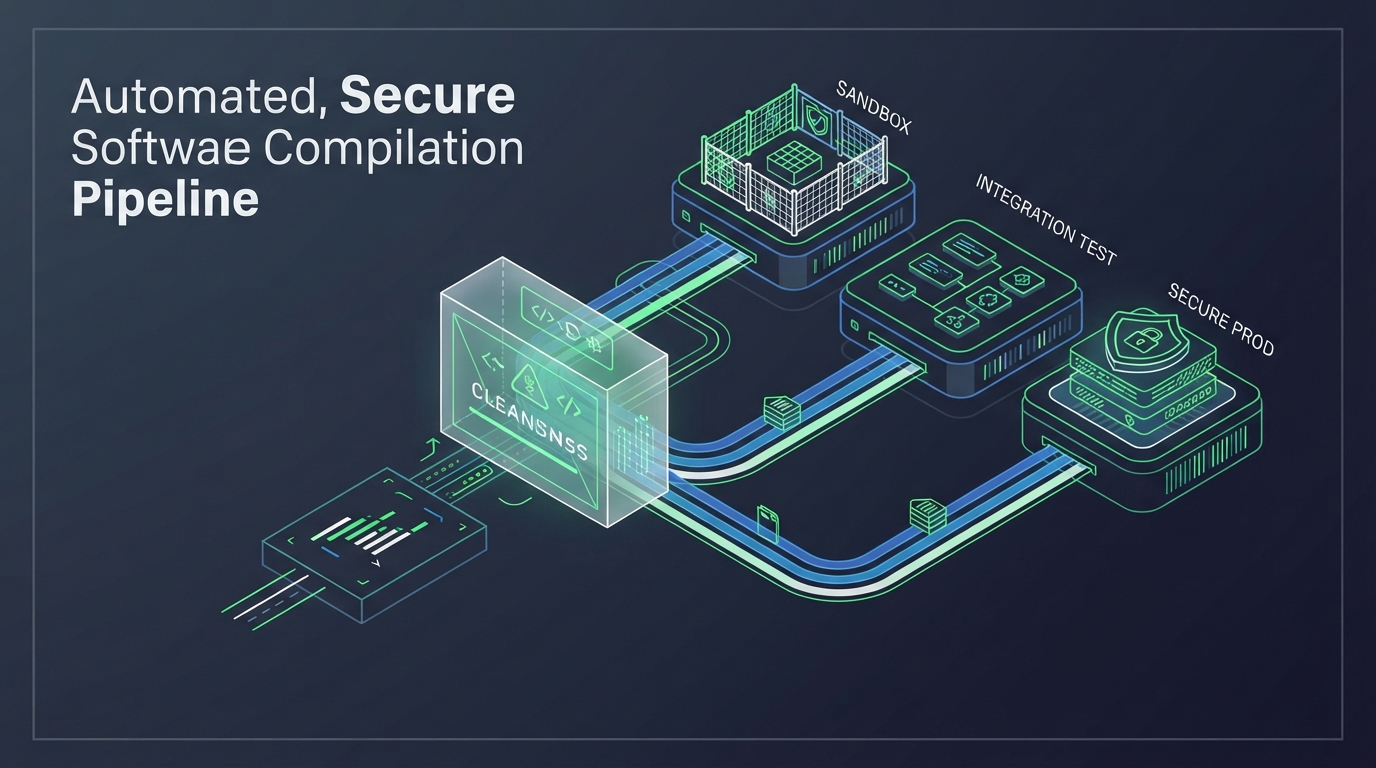
Revolutionizing Software Delivery: Securing AI-Driven Code at Speed
The Paradigm Shift in Software Pipelines The integration of Artificial Intelligence (AI) into software delivery is fundamentally transforming traditional engineering methodologies. Software delivery pipelines, which once relied on heavily structured human-managed development and rigid stage-gates, are pivoting to highly automated systems. While AI-driven development supercharges output, it creates a critical operational mismatch: code is being generated at a speed and scale that outpaces the capacity of traditional security infrastructure to review, parse, and validate it.
When an enterprise attempts to rely on legacy security practices in an AI-accelerated landscape, they inherit severe vulnerabilities. Passive human oversight becomes an artificial barrier that developers bypass to maintain velocity, causing unverified AI-generated code to be deployed directly to production. To build a secure, future-proof software ecosystem, organizations must move beyond point-in-time compliance and deploy continuous, programmatically enforced runtime defenses.
[AI Code Assistant] ──► [Legacy Static Scan] ──► (Triage Queue Bottleneck / Bypass) ──► [Vulnerable Prod]
[AI Code Assistant] ──► [Autonomous Sandbox] ──► (Deterministic Verification) ──► [Secure Prod]
The Hard Truth of Machine-Scale Vulnerabilities The security threat landscape is shifting rapidly. Recent disclosures, including multiple severe flaws discovered in the Linux kernel and key open-source libraries, underscore that legacy kernel modules and software supply chains remain highly vulnerable to complex exploits. When these underlying vulnerabilities are parsed by AI systems capable of identifying software flaws in seconds, the threat window shrinks dramatically.
Furthermore, developers are increasingly voicing skepticism regarding the safety and security of code produced by generic AI assistants. As software engineers in major development hubs have noted, many AI code assistants generate syntactically correct but fundamentally unsecure patterns. These models suffer from "attention drift" over large codebases, introducing outdated library versions, improper authentication boundaries, and legacy security bugs (such as symbolic link vulnerabilities or path traversal errors) directly into the code. Relying on basic AI generation without structural, isolated verification is a recipe for catastrophic system-level failures.
Beyond Passive SaaS: The Rise of Dual-Agent Operations In response to these emerging threats, the technology industry is shifting from traditional, passive Software-as-a-Service (SaaS) management tools to active, autonomous operational platforms. This transformation is highlighted by the rise of next-generation enterprise engines like Factorial—which recently secured a $150 million Series D investment at a $2.5 billion valuation to expand its highly automated, AI-driven operations.
Rather than functioning as passive databases, modern operations systems are engineered around dual-agent frameworks. This structure divides cognitive tasks to optimize both velocity and security:
The Agentic Learner: This agent continuously ingests, parses, and maps internal organizational workflows, compliance frameworks, and infrastructure policies, establishing a secure baseline of system-wide rules.
The Agentic Executor: This active agent works alongside developers, automating repetitive code construction, identifying dependency conflicts, and running immediate, pre-deployment compilations under the guardrails established by the Learner.
By splitting automated workflows between security policy enforcement and active generation, enterprises eliminate administrative friction, enabling software delivery to scale safely and smoothly.
The Technology Stack: Compiling Security at the Edge At the engineering level, securing AI-driven code requires building highly efficient, hardware-agnostic compilation pipelines. The traditional model of relying on bloated, slow-compiling software environments forces a compromise between thorough testing and developer speed. Developers must leverage modern, highly optimized compiler systems—such as those utilizing Zig or Bazel—to compile code dynamically across diverse hardware chipsets, including NVIDIA, AMD, and Apple Silicon.
Using ultra-fast compilers allows development teams to execute containerized integration tests and static security analysis in milliseconds rather than hours. This rapid execution loop ensures that every piece of AI-generated code is automatically compiled and verified inside isolated, sandboxed environments before it can be merged into the main codebase. By combining these fast compilation pipelines with cutting-edge models from Anthropic and OpenAI, organizations can construct automated, real-time code verification systems that run seamlessly in the background of any modern IDE.
Conclusion: Owning the Computational Blueprint The era of treating security as a separate, post-development step is over. With AI generating code at an unprecedented pace, unverified deployment represents an unsustainable risk to data sovereignty and infrastructure stability.
By transitioning from passive, human-in-the-loop approvals to automated, compile-level security sandboxing and dual-agent architectures, enterprises can confidently harness the speed of generative tools. Software engineering is moving past the phase of renting slow, fragmented compliance tools and entering a new era where organizations own their compilation pipelines, defend their digital perimeters at machine speed, and control their technological destiny.
Are you content to let unverified AI code slowly erode your system security, or are you ready to build a hardened, containerized compiler pipeline and fully own your engine room?
This article is part of our series on "Next-Gen Software Delivery and Security Architecture."
Sources
- 1.⚡ Weekly Recap: Linux Kernel Flaws, AI Malware Tricks, Turla Backdoor, Infostealers and More - The Hacker News
- 2.For software engineers, AI isn't just changing coding. It's changing careers, confidence, and identity. - Business Insider
- 3.What Are the Best AI Tools for Creating Content Faster in 2026? - Robotics & Automation News
Stay updated
Get our latest technical articles and product updates delivered to your inbox.