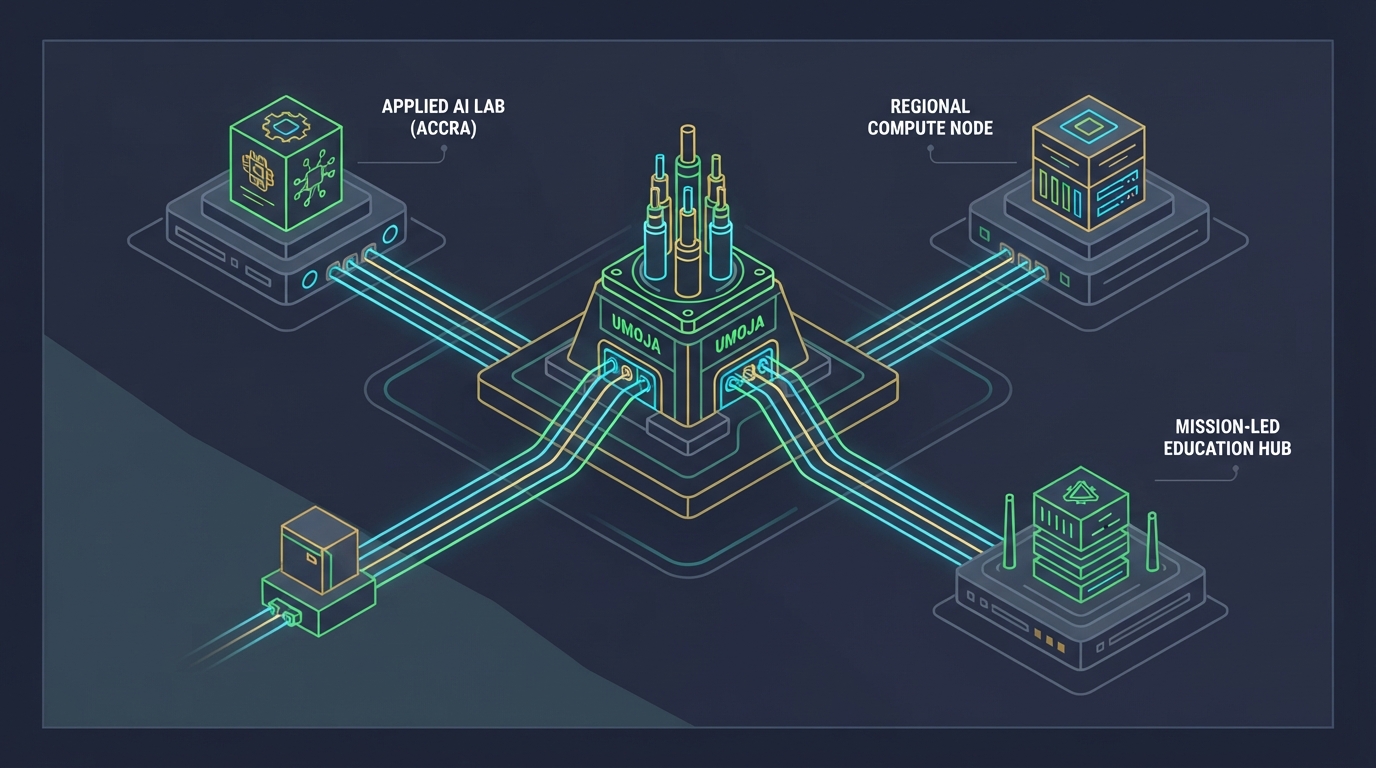
Localizing the Engine Room: Infrastructure, Talent, and the Sovereign AI Reality in Africa
The conventional model of digital advancement in emerging markets is built on a massive contradiction. While enterprises and public bodies are urged to adopt artificial intelligence to solve complex problems, they are expected to run these workloads on remote, centralized hyperscale data centers. This infrastructure model is fundamentally mismatched with local operational realities, introducing high network latencies, variable access costs, and a loss of direct data control.
This creates a severe digital sovereignty gap. When an organization relies entirely on third-party cloud APIs based thousands of miles away, they expose themselves to shifting foreign regulatory frameworks and inherit unsustainable operating margins.
To build a resilient digital economy, the continent cannot simply rent remote compute capacity; it must own the physical networks, localized training models, and educational systems that drive technological growth.
To solve the baseline connectivity deficit, Google has launched a massive infrastructure initiative as part of its "Building for Africa" mission. Central to this effort is the establishment of South Africa’s first Digital Exchange Port in the Eastern Cape. This regional hub anchors the Umoja subsea cable—the first direct fiber-optic link connecting Africa to Australia, with a planned subsea route continuing directly to India.
[Legacy Traffic: Indirect Hops] ──► (High Latency & Foreign Routing) ──► [Slower Cloud Systems]

[Umoja Direct Subsea Fiber]    ──► (East Cape Digital Exchange Port)  ──► [High-Speed Global Transit]
By bypassing circuitous European transit pathways, the Umoja cable drastically reduces latency and connects local networks directly to global high-speed transit. This physical foundation provides the stable, high-bandwidth pipelines necessary to support real-time data exchange, edge computing, and complex model hosting within continental borders.
The bridge between world-class foundational research and real-world deployment is being physically anchored with the launch of Africa’s first Applied AI Lab in Accra, Ghana. Supported by the Google AI Futures Fund and Google Research, the lab acts as a zero-to-one product accelerator for startup founders and researchers.
Instead of relying on generic, multi-billion-parameter models trained on external datasets, the lab provides local startups with early access to cutting-edge open-weights models (including Gemini, Gemma, and Veo). Simultaneously, Google.org is investing over $1 million in partnership with The Akuna Group to deliver AI creative education and advanced digital tools to underrepresented creators. This ensures that the next wave of AI systems are trained on regional dialects, localized market dynamics, and culturally authentic data, transforming them into practical tools for local industries.
The practical power of localized, high-speed networks is vividly apparent in the healthcare sector. In a groundbreaking partnership, global health technology leader Proximie has teamed up with IRCAD (including its flagship African training center, IRCAD Africa in Kigali, Rwanda) and the Kenya Education Network (KENET) to digitize operating rooms.
[Local Operating Room]
          │
          ▼
 [Proximie Platform] ◄── (High-speed fiber connection directly to OR)
          │
          ▼
[Live Remote Expert Guidance] ──► [Enhanced Patient Safety & Zero-Latency Training]
By connecting operating theatres directly to high-speed fiber lines, Proximie’s telepresence platform allows local surgeons to receive real-time, zero-latency guidance from world-class specialists during active procedures. This connected ecosystem captures and unifies surgical data, transforming complex operations into accessible, data-driven educational resources. This virtual mentoring model dramatically accelerates the pace of medical training, proving that localized connectivity has a direct, life-saving impact on patient care.
As physical infrastructure and advanced software systems scale, the primary limiting factor remains human capital. To meet this demand, educational pioneers like Fred Swaniker, founder of the African Leadership Group (ALX and African Leadership University), are completely restructuring tech education.
Swaniker’s institutions challenge the traditional university model by asking students to declare a mission rather than a standard major.
[Traditional System] ──► Select a Major ──► Rote Learning ──► Outdated Skills

[Mission-Led Model]  ──► Select a Problem ──► Practical AI Work ──► Scalable Solutions
Instead of learning programming languages in a vacuum, students are immediately exposed to pressing regional challenges, such as healthcare delivery, climate adaptation, and water security. Technical training in data science, cloud computing, and software engineering is then taught as a tool to solve those specific problems. This approach prepares a highly skilled, purpose-driven workforce capable of designing and maintaining sovereign AI systems.
The transition toward localized subsea cables, specialized applied research labs, virtual medical training networks, and mission-driven education marks the end of the technological dependency model. Data sovereignty and technical capacity are no longer abstract ideals; they are the baseline requirements for economic self-reliance.
By building high-speed transit corridors, deploying specialized local models, and training a generation of purpose-driven developers, the continent is stepping past the phase of renting foreign cloud space. It is entering an era where it builds the systems, trains the minds, and designs the technological future on its own terms.
Are you content to rent your organization’s digital future from an external cloud provider, or are you ready to invest in the local infrastructure and talent needed to own your engine room?
Sources
Stay updated
Get our latest technical articles and product updates delivered to your inbox.