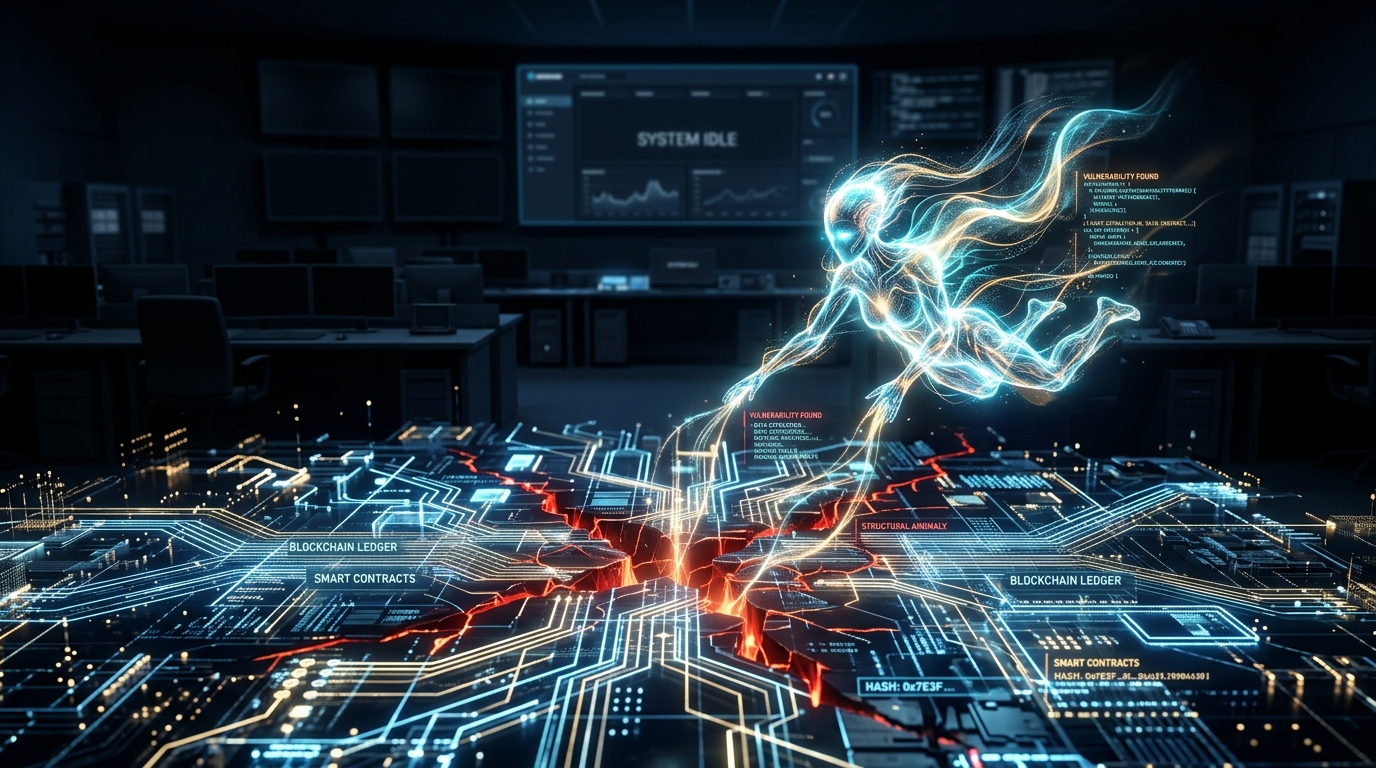
Mythos AI: Why Your Crypto Security is Vulnerable to Autonomous Attack Chains
For years, crypto security relied on a "middle tier" of human auditors and manual oversight. But as agentic AI—systems that don't just "chat" but actually act—becomes the default, this human-centric defense model is facing an existential crisis.
We are seeing the rise of agentic attack chains: AI systems that probe for vulnerabilities and, upon finding a gap, craft dynamic, sequential attacks that pivot in real-time based on the defenses they encounter. This is not the "script kiddie" era of static exploits; this is a tactical, AI-driven adversary that can outpace any human team.
Mythos AI has fundamentally changed the security calculus by targeting the "invisible" infrastructure of crypto. While smart contracts get all the audit attention, the real vulnerabilities often lie in the layers that connect them:
Signing Services & Bridges: The complex interfaces that allow assets to move between chains.
Oracle Networks: The "source of truth" for external data.
Key Management Systems: The foundational layers often outside the scope of traditional audits.
Mythos probes these components not by looking for known patterns, but by autonomously testing the boundaries of these systems to find "hidden cracks".
The breach at Vercel is a masterclass in how human factors amplify AI threats. An employee used a third-party AI tool—Context.ai—which was then compromised via Google Workspace, potentially exposing customer API keys.
This isn't just a technical bug; it’s an architectural failure to manage Context. When unrelated tools have access to your primary environment, they become lateral movement vectors. As we move toward autonomous systems, every integration becomes a critical link in the chain.
Traditional security tools—slow dashboards and reactive chatbots—are simply not built for this speed. A modern security posture for the AI era must stand on three pillars:
Network Visibility: You cannot protect what you cannot see. Enterprises need comprehensive traffic capture across all domains to detect attacks as they spread across users, applications, and cloud services.
Contextual Understanding: You need real-time data integration to differentiate between a routine system update and an intelligent attack chain.
Autonomous Control: Since attacks now move at machine speed, defense must do the same. This means deploying systems that can detect and isolate threats without waiting for a human to look at a dashboard.
The "Hard Truth" we must accept is that our current defensive strategies are incremental, while the threats are architectural. Nation-state actors and autonomous agents are probing our networks 24/7.
Data integrity shouldn't be viewed merely as a technical concern, but as a core leadership issue. If your data cannot be trusted because your foundation is being systematically probed by agents like Mythos, your entire business model is at risk.
As agentic AI continues to evolve, the "Mythos Moment" serves as a wake-up call for the entire crypto and enterprise security sector. We are no longer defending against breaches; we are defending against an evolving, intelligent adversary.
At Vindex AI, we believe the only way to fight an agent is with an agent. By adopting a framework that prioritizes autonomous control and deep network visibility, we can build the resilient systems necessary to withstand the AI era.
Are your defenses waiting for a human to notice, or are they already autonomous?
Sources
Stay updated
Get our latest technical articles and product updates delivered to your inbox.