The Scaling Mirage: Why Smaller, Domain-Specific Models Are Winning the AI Race
The False Promise of Infinite Scale For years, the generative AI landscape has been governed by a singular, dogmatic belief: bigger is always better. This "scaling law" suggested that any intellectual or technical bottleneck could be solved by simply injecting more parameters, more training data, and more compute power into foundation models.
This obsession has created a severe operational bottleneck. When an enterprise attempts to deploy these massive models for real-world tasks, they quickly realize that brute-force scaling does not yield linear improvements. Instead, it introduces extreme computational waste, high operational costs, and unpredictable system failures.
[Legacy Strategy: Brute-Force Scale] ──► [Bloated Multi-Billion Parameter LLM] ──► [High Latency & Critical Errors]
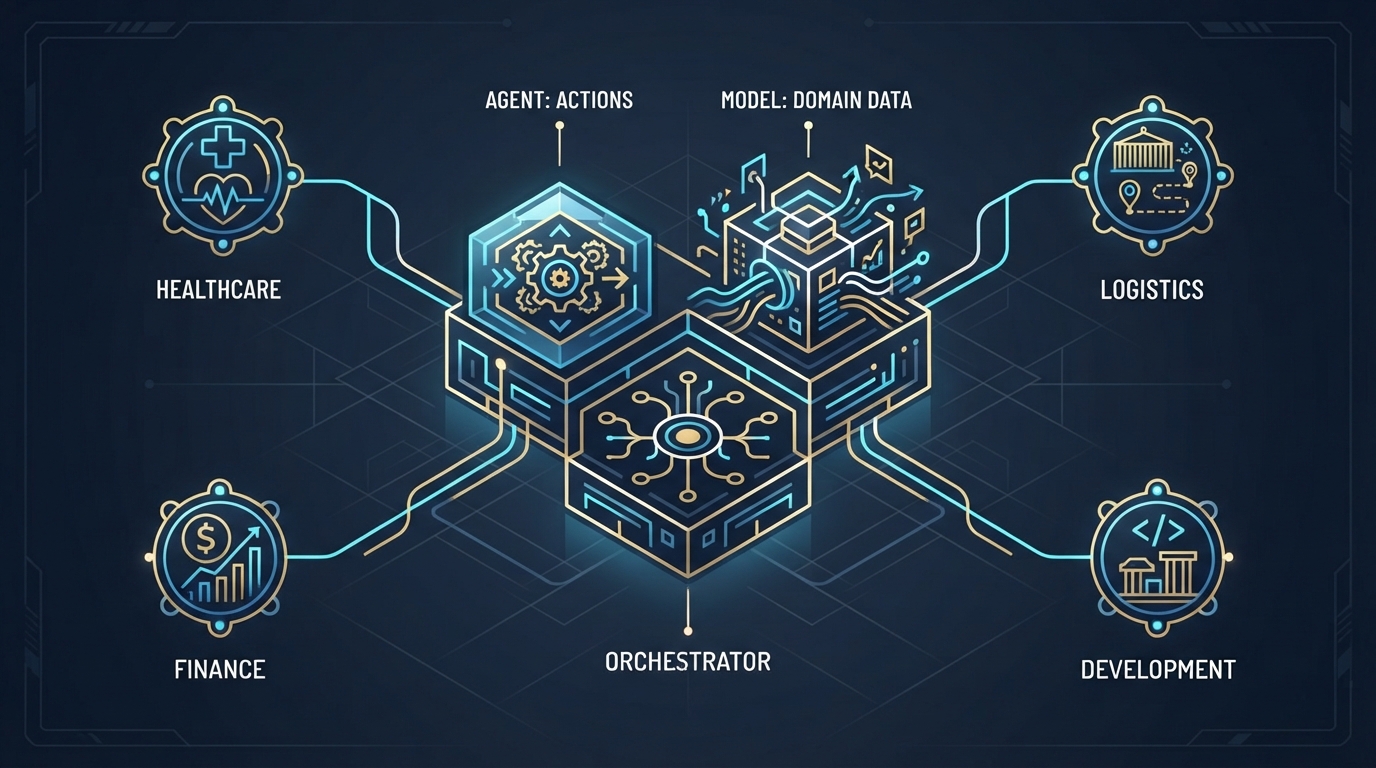
[Modern Strategy: Target Efficiency] ──► [Small, Domain-Tuned Models + Agents] ──► [High Accuracy & Low Unit Cost] To build a reliable digital infrastructure, organizations must stop chasing raw parameter counts. True computational value lies in deployment readiness, domain expertise, and structural efficiency.
The Quadratic Cost of Complexity The assumption that large language models scale cleanly as input size increases is a mathematical illusion. In reality, the computational complexity of standard transformer architectures scales quadratically with context length, leading to severe performance degradation and skyrocketing token-serving costs.
As highlighted by recent analysis in The Atlantic, this technical reality is exposing generative AI as an engineering challenge that cannot be solved by hardware alone. The exponential rise in energy consumption and server overhead required to process longer prompts is financially unsustainable for most businesses. Rather than unlocking higher intelligence, massive input contexts often degrade model output, leading to "attention drift" where the model completely misses crucial details buried in the middle of a prompt.
The Clinical Peril of Unverified Training The consequences of relying on a generalized, uncalibrated scale become dangerously apparent in high-stakes fields like medicine. When general-purpose LLMs are expected to handle highly specialized tasks without strict domain boundaries, their lack of clinical grounding can lead to life-threatening errors.
                           ┌──► Generalized LLM Training (Internet Data)
                           │         │
                           │         ▼
[High-Stakes Clinical Query] ─────┤ [Hallucination / Outdated Advice] (Critical Patient Risk) │ │ └──► Domain-Validated Model (Expert Verified) │ ▼ [Adherence to Guideline Standards] (Safe Patient Care) A study published in Nature exposed this vulnerability when testing major AI models' ability to provide treatment advice for highly complex conditions like anaplastic thyroid cancer. The models routinely struggled to adhere strictly to established clinical guidelines, demonstrating that massive scale does not equate to clinical accuracy. Without explicit domain-specific fine-tuning, version tracking, and rigorous expert verification, general-purpose LLMs remain too unpredictable for critical decision-making environments.
The Agentic Pivot: Prioritizing Action Over Size To bypass the limits of model size, forward-thinking tech giants are changing how they define model capability. Instead of trying to build a single, all-knowing brain, companies are focusing on building nimble, action-oriented systems.
A prime example is Tencent’s strategic deployment of its Hunyuan model series. Rather than entering a race to build the world’s largest monolithic model, Tencent has heavily focused on building highly efficient, agent-centric frameworks. These "AI agents" use smaller, specialized underlying models to execute specific tasks—such as automated coding, customer workflow routing, or rapid data retrieval. By prioritizing how a model interacts with external tools and orchestrates workflows rather than focusing on its raw parameter scale, organizations can deliver superior user value at a fraction of the hardware cost.
Conclusion: Owning the Computational Engine The era of blind, unoptimized scaling is drawing to a close. Parameter size is no longer a reliable proxy for real-world utility; deployment efficiency, domain authority, and agentic execution are the new metrics of success.
By abandoning the chase for massive general-purpose models and investing in highly calibrated, task-specific systems, enterprises establish a lean, predictable baseline for growth. The tech sector is moving past the phase of renting massive, unstable external models and entering an era where organizations own their specialized intelligence engines.
Are you going to keep renting a massive, uncalibrated model that struggles with your industry's specific realities, or are you ready to build and control a highly efficient engine room of your own?
Sources
Stay updated
Get our latest technical articles and product updates delivered to your inbox.