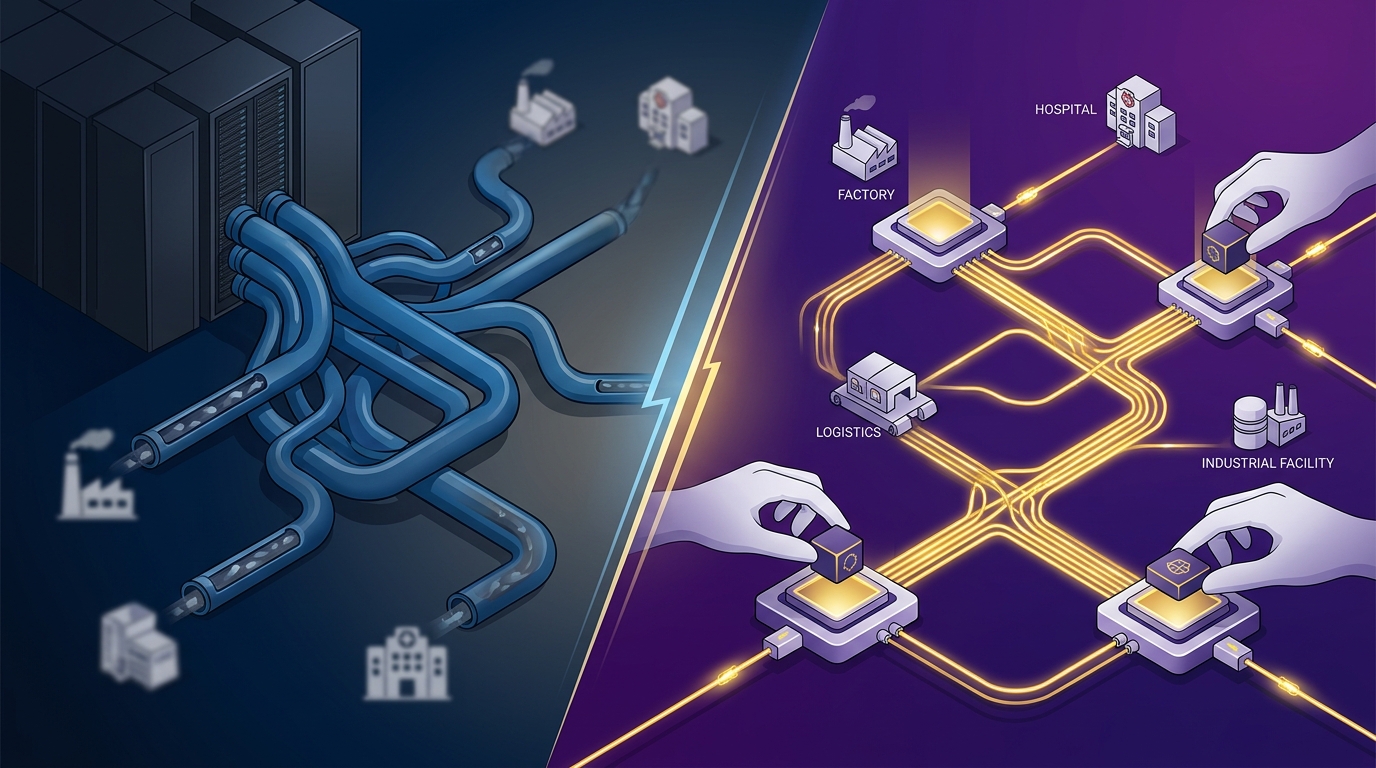
Edge Computing Takes Center Stage: Why AI Infrastructure is Shifting to the Edge
For the last decade, infrastructure engineering operated under a single assumption: centralization was king. Compute resources were thought to be best managed from massive cloud data centers, where they could be pooled, optimized, and scaled.
However, a pivotal shift is occurring. Organizations are realizing that a centralized model no longer serves the high-stakes requirements of production AI. Central power concentrations are becoming operational bottlenecks. As Neel Khokhani of Professional Wealth Management notes, distributing compute across smaller sites and aligning it with local energy production dramatically mitigates the strain of power-dense AI operations. This isn't just an energy-saving play; it's a structural realignment designed to bring inference closer to where data is actually generated and consumed.
The immediate dividend? Processing response times collapse from a sluggish 50–100ms down to mere milliseconds, all while hardening security through localized control.
The barrier to running edge infrastructure has historically been the orchestration overhead. Running a model on a local rig is simple; managing secure, persistent, and isolated production environments across distributed endpoints is a nightmare.
That infrastructure layer is finally being built out. Tools like BerriAI’s newly open-sourced LiteLLM Agent Platform are showing exactly what self-hosted production stacks look like. Instead of relying on a third-party managed cloud to handle session histories and agent logic, teams are deploying native infrastructure layers directly onto their own hardware.
Isolated Sandboxes: Relying on Kubernetes custom resource definitions (
kubernetes-sigs/agent-sandbox), each agent or execution context is completely sandboxed on local clusters.Persistent Sessions: State and session memory stay alive across pod restarts and upgrades without requiring external session stores.
Sovereign Gateway Routing: The underlying LiteLLM Gateway acts as the control plane, allowing developers to route traffic across hundreds of models seamlessly while keeping the operational logs local.
Moving away from centralized cloud APIs introduces what TechTarget calls a complex cost calculus for IT organizations. While running open-weights models locally on edge nodes eliminates unpredictable API usage fees, it exchanges op-ex for cap-ex and engineering overhead.
When you shift to an edge or hybrid cloud model, your engineering team inherits the responsibility of building and maintaining:
CI/CD and Observability: You need dedicated monitoring to know whether an edge agent is drifting from its intended behavior or making erratic state decisions.
Resource Quotas: Standardized limits per container to ensure a single runaway local execution loop doesn't cripple the surrounding industrial, hospital, or corporate endpoint.
Secret Security: Standardized prefix systems (like stripping
CONTAINER_ENV_prefixes at runtime injection) to safely pass credentials to local sandboxes without hardcoding secrets into your local disk images.
As we re-architect our technical stacks to live at the edge, we have to rethink who is building them. In our previous deep dives into universal accessibility, we highlighted that technology built exclusively by homogenous engineering teams creates massive design liabilities.
True innovation at the edge requires the integration of diverse, real-world perspectives. If our local systems are deployed into factories, clinical clinics, and public infrastructure, they must be architected by individuals who navigate the physical and digital world differently. Bringing disabled creators and engineers with varied lived experiences into the design layer ensures that edge interfaces aren't just faster—they are universally accessible. The move toward edge processing must go hand-in-hand with an engineering culture that recruits, retains, and empowers developers who understand human-centric constraints from the ground up.
The "Hard Truth" of the infrastructure landscape is that renting cloud intelligence is a transitional phase. Centralized data centers are exceptional for initial prototyping and massive baseline training. But when an AI agent needs to act autonomously within a localized workflow, relying on a fiber optic round-trip to an external server is an architectural liability.
The edge forces a "System Thinking" discipline. You can no longer rely on a cloud provider’s black-box security protocols. You must own your runtime, monitor your state drift, and secure your execution sandboxes natively.
The centralization model is fracturing. The rise of self-hosted, Kubernetes-native tools like the LiteLLM Agent Platform proves that the future belongs to teams who control their own compute. Bringing your AI models closer to the edge guarantees data sovereignty, removes the latency penalty, and provides a predictable cost structure that centralized APIs simply cannot match.
Are you still renting your operational capacity from the cloud, or are you ready to own the infrastructure layer on your own terms?
Sources
- 1.AI infrastructure boom shifts closer to the edge - Professional Wealth Management
- 2.Meet LiteLLM Agent Platform: A Kubernetes-Based, Self-Hosted Infrastructure Layer for Isolated Agent Sandboxes and Persistent Session Management in Production - MarkTechPost
- 3.IT orgs face tricky cost calculus for self-hosted AI inference - TechTarget
Stay updated
Get our latest technical articles and product updates delivered to your inbox.