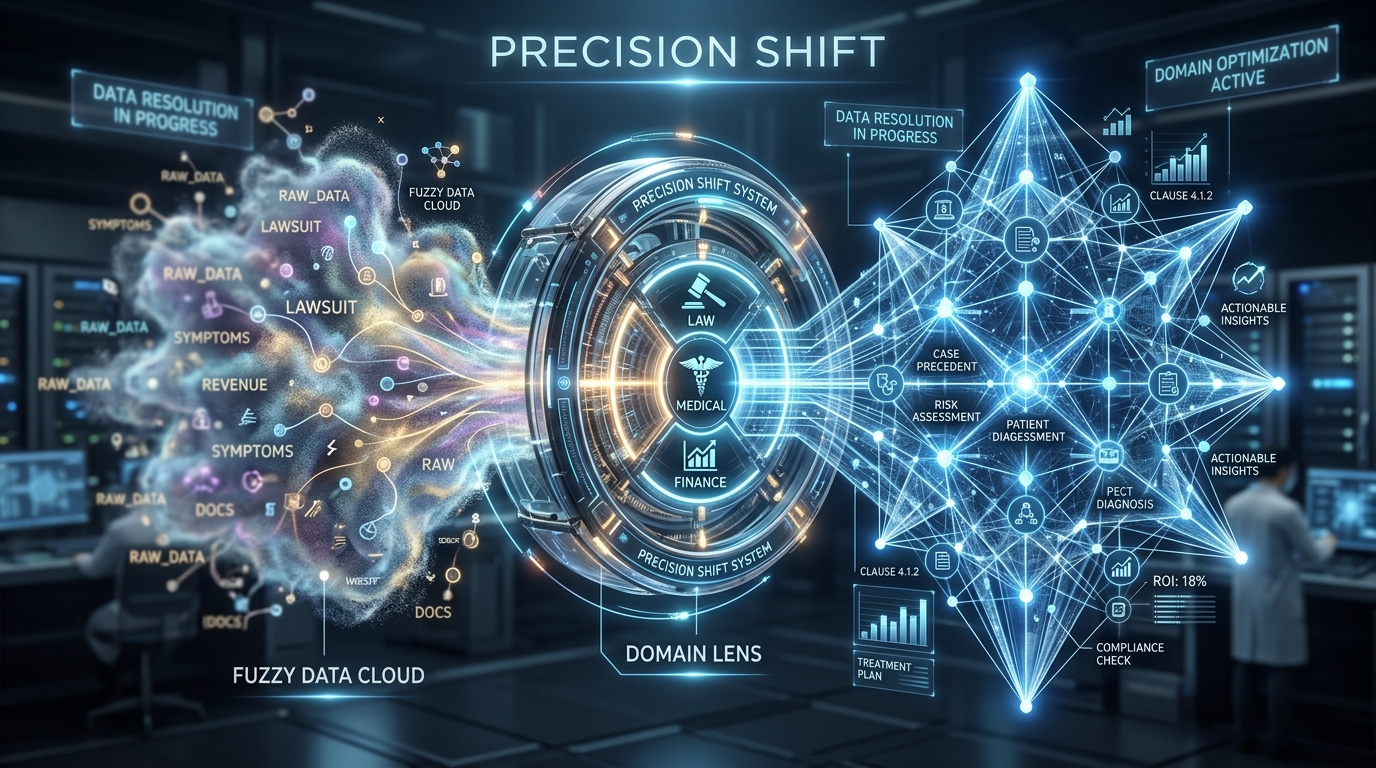
The Precision Era: Why Domain-Specific LLMs are the New Foundation for ROI
For years, the industry relied on the "generalist" model—an AI that could write a poem just as easily as it could summarize a medical report. But for the enterprise, this is a liability. A general-purpose model treats a legal contract with the same "fuzzy" logic as a movie script. In a courtroom or a clinical setting, that lack of precision isn't just an inconvenience—it’s an operational risk.
We are witnessing a pivotal shift toward domain-specific LLMs. These models are fine-tuned on expert-curated datasets, making them the first AI tools that actually "speak the language" of the professional.
Specialization allows organizations to process massive volumes of information with unprecedented efficiency.
Legal Services: Models like DeepSeek V4 Pro are transforming legal practice by integrating deep professional knowledge, reducing the time spent on routine drafting and validation tasks.
Healthcare Impact: Specialized tools like PsychFound allow clinicians to review patient histories and EHR data with higher precision, enabling more accurate diagnoses and treatment planning.
Workflow Upgrades: This isn't just "automation"; it is the fundamental upgrading of the entire professional workflow.
The rise of domain-specific models also forces a total rethink of security. In crypto and finance, we used to rely on human auditors and manual oversight. Now, we face the rise of agentic attack chains—AI systems that autonomously probe for vulnerabilities and craft sequential attacks that pivot in real-time.
Tools like Anthropic’s Mythos AI have exposed "hidden cracks" in the infrastructure—the bridges, oracles, and signing services that sit outside the scope of traditional smart contract audits. To defend against these agentic threats, security must be just as autonomous as the attacks it faces.
For business leaders, the value proposition of domain-specific models is straightforward:
Reduced Validation Tax: Because the outputs are contextually relevant, professionals spend less time manually correcting hallucinations.
Faster Implementation: Specialized models require less "prompt engineering" to get to the desired result.
Reliability: By training on industry-specific data, these models provide the high-quality, actionable insights needed to justify large-scale AI investment.
Building these models requires more than just raw data—it requires rigorous engineering.
Hyperparameter Optimization: To ensure models converge correctly, teams are using systematic grid searches for learning rates, batch sizes, and optimizer choices.
Privacy-Preserving Inference: The F-Transformer model is emerging as a critical tool, leveraging federated learning to train on distributed data without centralizing it, which is essential for compliance in healthcare and finance.
The hard truth of 2026 is that while domain-specific LLMs offer a clear path to ROI, they are not "plug-and-play." They require dedicated data governance, continuous validation, and a commitment to maintaining the human-on-the-loop oversight that high-stakes industries demand.
The era of the "generalist AI" is effectively over. As we move into the second half of 2026, domain-specific LLMs will become the indispensable infrastructure for modern professionals. Whether you are in healthcare, finance, or law, the models that succeed won't be the ones that are the "most powerful" in a vacuum—they will be the ones that are the most accurate within the specific, messy reality of your industry.
Are you ready to move past the "chat" and start building for "precision"?
Sources
Stay updated
Get our latest technical articles and product updates delivered to your inbox.