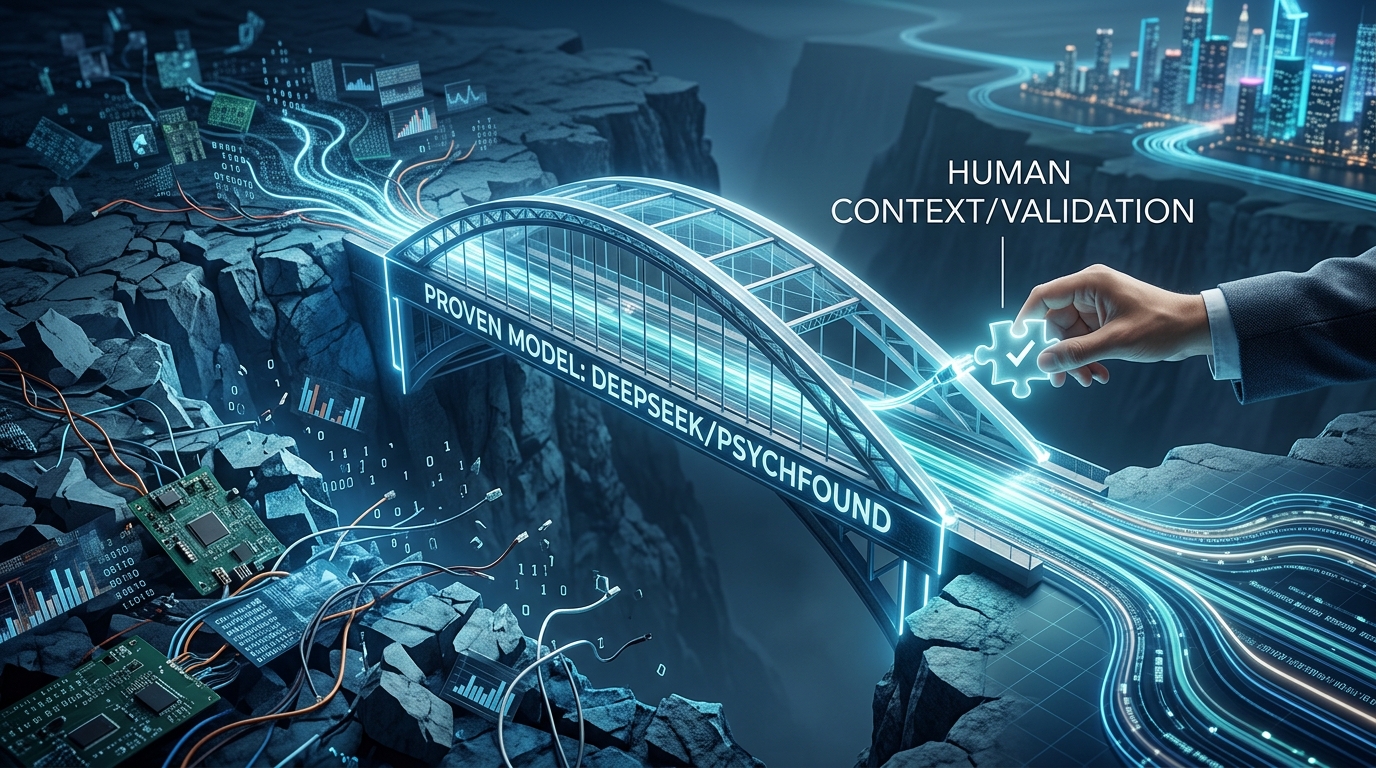
Closing the Gap: Why Proven Models Need Human Context to Matter
For years, the tech industry relied on a robust "middle class"—developers writing boilerplate code, analysts manually summarizing reports, and managers coordinating efforts. However, as agentic AI—systems that don't just "chat" but actually "act"—becomes the default, this middle tier is facing an existential crisis.
The release of DeepSeek V4 Flash and V4 Pro, with their high-efficiency mixture-of-experts architecture, has officially commoditized frontier-level performance. But this isn't just a tech story. As the cost of intelligence drops, we must ask: how do these breakthroughs impact high-stakes industries like mental health and cybersecurity?
The Linux kernel community is currently a canary in the coal mine. They are drowning in "slop"—low-quality, automated bug reports generated by AI that create more work for maintainers than they solve. The current strategy of relying on massive, cloud-based models is hitting a wall because these systems lack the deep, local context necessary for precision.
This is why on-prem solutions are becoming the new standard. Efficiency isn't just about token speed; it's about accuracy in context.
Mental health is facing its own crisis, with nearly one billion individuals worldwide needing care and a massive workforce shortage standing in the way. Large language models like PsychFound are stepping in to bridge this gap.
PsychFound integrates professional psychiatric knowledge and clinical reasoning capabilities into its architecture. However, a significant "friction point" remains: most models are patient-oriented and don't align with real-world clinical workflows. While PsychFound can support clinicians in complex tasks like diagnostic reasoning and treatment planning, it still requires human oversight for full efficacy. In mental health, AI is a tool to empower the clinician, not to replace the human connection.
The emergence of models like Anthropic's Mythos and OpenAI's GPT-5.5 has sparked fears of "industrialized mass exploitation"—an era where AI agents autonomously find and weaponize vulnerabilities at scale.
However, there is a technical caveat. While LLMs like Mythos have achieved massive gains in finding "shallow bugs" (low-severity, easily detectable flaws), the most critical exploits still require the human element. As RunSybil CEO Ari Herbert-Voss notes, AI is excellent at generating noise, but humans are still required to filter, validate, and understand the root causes of vulnerabilities to prevent "resource wastage" on false positives.
The "hard truth" across every sector—from the hospital to the server room—is that proven models like DeepSeek V4 Flash and V4 Pro only succeed when they are integrated into human-centric workflows.
In Care: AI handles the synthesis of professional knowledge, allowing the doctor to focus on the patient.
In Security: AI scans the "shallow" vulnerabilities, allowing the researcher to focus on the complex, deep-rooted architectural flaws.
In Engineering: AI handles the boilerplate, allowing the developer to focus on system-wide logic.
Closing the gap with frontier models is a monumental achievement for the open-weights community. But the "final mile" of digital transformation isn't found in a benchmark; it’s found in the integration of technology with human expertise.
As we enter the era of agentic AI, our focus at Vindex AI remains clear: we don't just use technology to replace human effort; we use it to make that effort more meaningful.
Are you building a system to replace your experts or a platform to empower them?
Sources
Stay updated
Get our latest technical articles and product updates delivered to your inbox.