Bypassing the RAG Trap: Why Structured Knowledge Beats Vector Search
If you’ve spent any time building Retrieval-Augmented Generation (RAG) systems lately, you’ve likely hit "the wall." You chunk your data, embed it into a vector database, and set up a cosine similarity search. It feels like magic—until it doesn't.
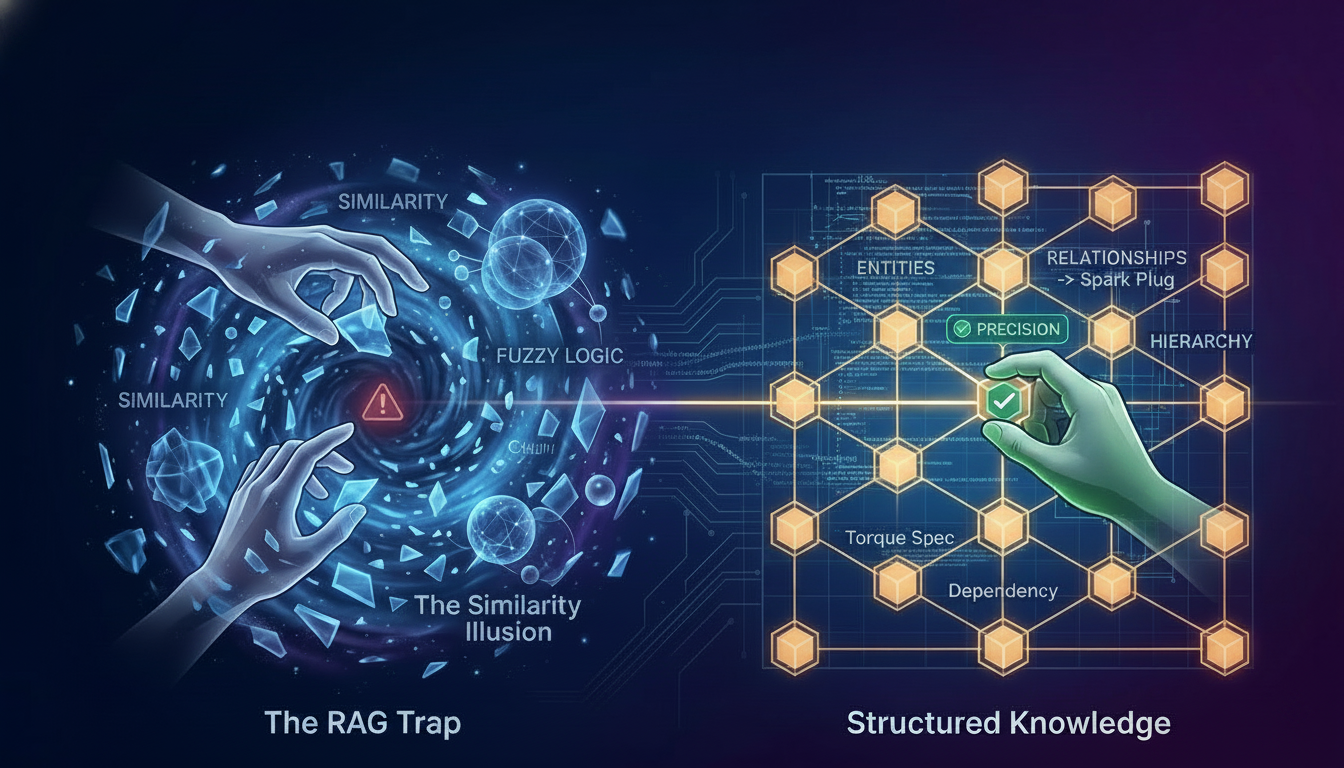
The problem is that vector search is fundamentally based on "vibes." It finds things that are related in a high-dimensional space, but it has no concept of logic, hierarchy, or facts. For complex tasks, "similar" is often just a fancy word for "wrong." As Andrej Karpathy has hinted at, the future of personal AI—our "Second Brains"—won't be built on a pile of raw, unstructured chunks. It will be built on structured, curated knowledge.
Vector RAG treats your data like a giant soup. When you ask a question, the system ladles out a few chunks that look like they might be relevant. But if you’re building an engineering tool or a legal assistant, "looking relevant" isn't enough.
Traditional RAG struggles with:
Relationship Mapping: It can’t easily tell the difference between "Product A is better than Product B" and "Product B is better than Product A" if the keywords are the same.
Complete Context: It often misses the "big picture" because it’s only looking at isolated snippets of text.
Deterministic Accuracy: You can't guarantee it will find the specific, obscure edge case buried in a 500-page manual if the embedding happens to be slightly off.
Structured knowledge is about creating a deliberate map of information. Think of it as moving from a pile of loose papers to a highly indexed library. This is where the concept of "Knowledge Graphs" or structured "Second Brains" comes in.
When you structure knowledge, you define entities and the explicit relationships between them.
The Vector Approach: Finds "Engine" and "Spark Plug" because they often appear together.
The Structured Approach: Knows that a Spark Plug is a component of an Engine and has a specific torque specification.
For an AI to act as a true partner, it needs to understand these hierarchies. It needs to know that a change in one module of your code affects another not just because they are "similar," but because there is a functional dependency.
Here is the hard truth we have to face at AmgapTech: Structured knowledge is harder to build. Vector RAG is popular because it's lazy. You can set it up in an afternoon with a Python script and a Pinecone account. Building a structured knowledge base requires:
Intentional Schema Design: Deciding how data should be categorized.
Pre-processing Overhead: Using LLMs or manual effort to extract entities and relationships before they are stored.
Maintenance: Keeping the structure updated as information changes.
But while the "cost to build" is higher, the "cost of failure" is much lower. In production, a structured system is more reliable, easier to debug, and significantly more efficient.
We aren't saying vectors are useless. The real breakthrough happens when we use a hybrid approach. We use vectors for the "fuzzy" discovery and structured data for the "hard" reasoning.
Imagine a personal AI that manages your projects. It uses vector search to find that one meeting note from six months ago, but it uses its structured knowledge of your team’s hierarchy and current sprint goals to understand why that note is important today. It turns raw information into actionable intelligence.
The "First Brain" of AI was about generative chat. The "Second Brain" will be about reliable, structured memory.
At AmgapTech, we’re moving away from the "chunk-and-pray" method of RAG. We’re building systems that understand the structure of the data they are handling. Because at the end of the day, an AI that can recite a million facts is just a toy. An AI that understands how those facts relate to your specific goals is a tool.
Are you building a search engine, or are you building an intellect? The answer lies in how you treat your data.
Sources
Stay updated
Get our latest technical articles and product updates delivered to your inbox.