Beyond the Shallow Buzz: How LLMs are Revolutionizing Data-Driven Decision Making
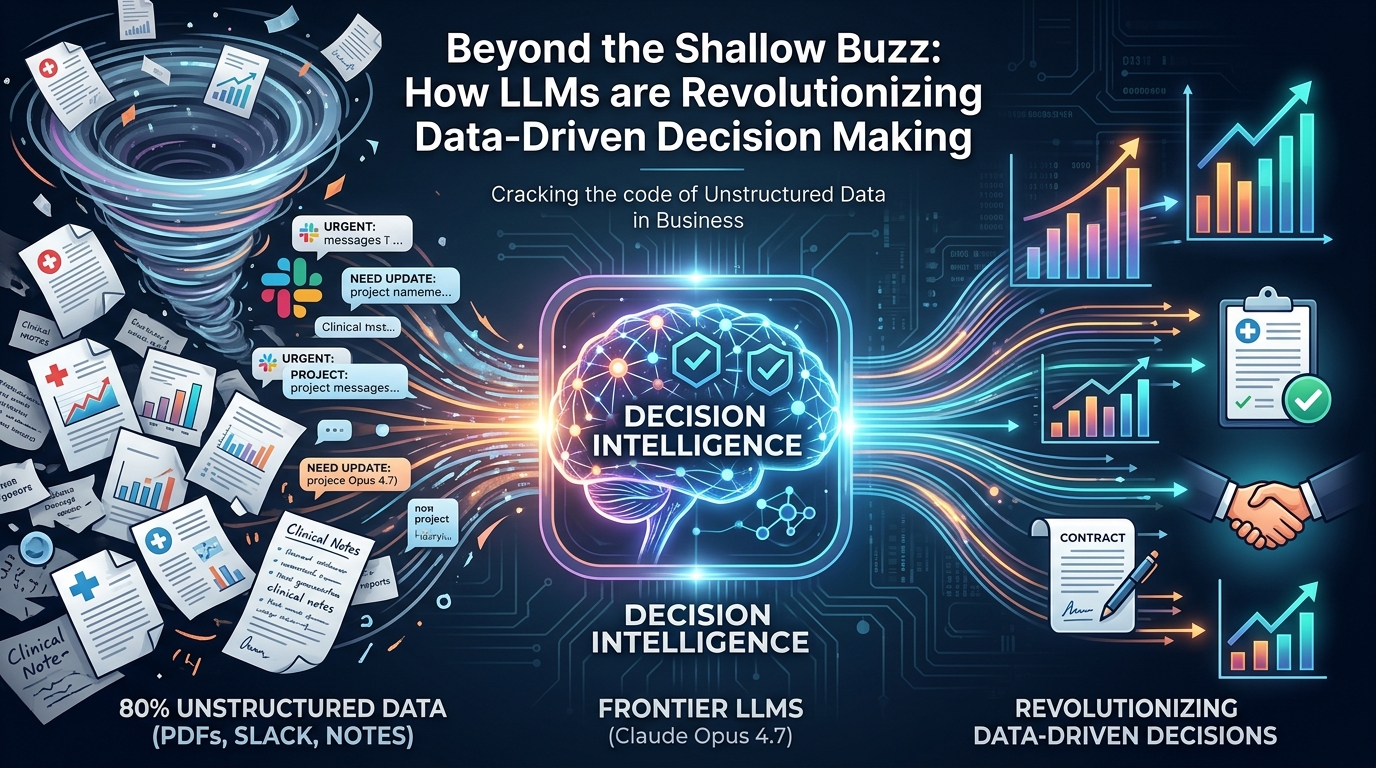
The Unstructured Trap In every industry—from tech to healthcare—we’ve had a "data gap." We have mountains of information, but because it lives in "unstructured" formats (prose, reports, transcripts), it might as well not exist for traditional analytics. We’ve used NLP in the past, but it was a blunt instrument—it could find keywords, but it couldn't understand context.
The "Shallow Buzz" was about AI that could write a poem. The "Revolution" is about AI that can read a 50-page clinical narrative and accurately identify a missed medical diagnosis. We are moving from Search to Synthesis.
Claude Opus 4.7: The New Heavyweight of Reasoning Anthropic’s release of Claude Opus 4.7 this week has fundamentally shifted the "sweet spot" for enterprise data processing. While previous models were impressive, they often required close human supervision for complex engineering or financial tasks.
Opus 4.7 changes the ROI of decision-making:
Self-Verification: It doesn't just give an answer; it devises ways to verify its own outputs before reporting back. This is critical for data-heavy industries where a "hallucination" isn't just a quirk—it's a liability.
High-Res Context: With a 3x upgrade in vision resolution (up to 2,576px), it can now "read" complex diagrams, architectural blueprints, and dense spreadsheets that were previously too blurry for AI to ingest.
The "Extra High" Effort Mode: It introduces a new xhigh effort level, allowing us to trade latency for deeper reasoning on the hardest problems. We can now choose: do we want a "fast" answer or a "correct" one?
Industry Deep-Dive: The Keebler Health Model The most exciting thing isn't the models themselves but how they are being specialized. Keebler Health just raised $16M to solve one of healthcare's biggest headaches: risk adjustment.
Historically, risk adjustment relied on "retrofitting" old NLP tools to find specific codes in provider notes. It was a manual, error-prone mess. Keebler is building an LLM-native platform that processes the "patient narrative" directly. Instead of looking for keywords, it understands the story of the patient's health.
The Impact: They are surfacing "Hierarchical Conditional Category" (HCC) coding opportunities that traditional systems simply missed.
The Result: Better revenue capture for providers and a more holistic view of patient health—all without making the doctor type more into a rigid form.
The "Sweet Spot": Performance vs. Cost At AmgapTech, we get asked the same question constantly: "Which model should we use?" With Opus 4.7, the answer is finally stabilizing. While "Mythos Preview" might hold the raw performance crown, Opus 4.7 is the "Workhorse." It maintains the same pricing as its predecessor ($5/1M input, $25/1M output) but delivers a nearly 10% jump in agentic coding and complex reasoning.
For a business, this is the "Sweet Spot." You get frontier-level intelligence at a predictable, production-scale price point.
The Hard Truth: Narratives are Messy Here is the technical trade-off: Understanding a story is computationally expensive. While LLMs can now process unstructured data, they are "verbose." They think more and produce more output tokens, especially at higher effort levels. The "Hard Truth" is that while you save on human labor, your compute costs will rise. You aren't "saving" money as much as you are "reallocating" it from slow human review to fast, scalable machine synthesis.
Conclusion: The End of the Spreadsheet Era The most valuable data in your company is currently "invisible" to your software. It’s sitting in your emails, your project briefs, and your meeting recordings.
The products that will win this year are the ones that stop trying to force users to fill out more forms and instead build an AI layer that can read the narrative they’ve already written.
Are you still building boxes for your data, or are you finally building a system that can read?
Sources
Stay updated
Get our latest technical articles and product updates delivered to your inbox.