Beyond the Bubble: Why Your Product Needs an AI Layer, Not Just a Bot.
Software has evolved, but our patience has disappeared. We’ve reached a breaking point where users are tired of "operating" systems. They don't want to dig through dashboards, hunt for help articles, or wait three hours for a support ticket to be seen.
They want instant answers and, more importantly, zero-effort results.
Most products try to fix this by slapping a chatbot on top. But a chatbot is just a band-aid. The real shift is deeper: moving from a product that requires a manual to an AI Layer that works on the user's behalf.
For decades, we’ve forced humans to learn the "language" of software—where the buttons are, how the forms work, and how the workflows flow. This creates friction.
The modern expectation is shifting the burden back to the machine:
Old Way: Interfaces → Navigation → Clicking.
New Way: Intent → Conversation → Execution.
A chatbot talks about the shift. A full AI layer completes it.
Chatbots are great at answering questions, but users don’t log into your product to have a chat. They log in to get things done.
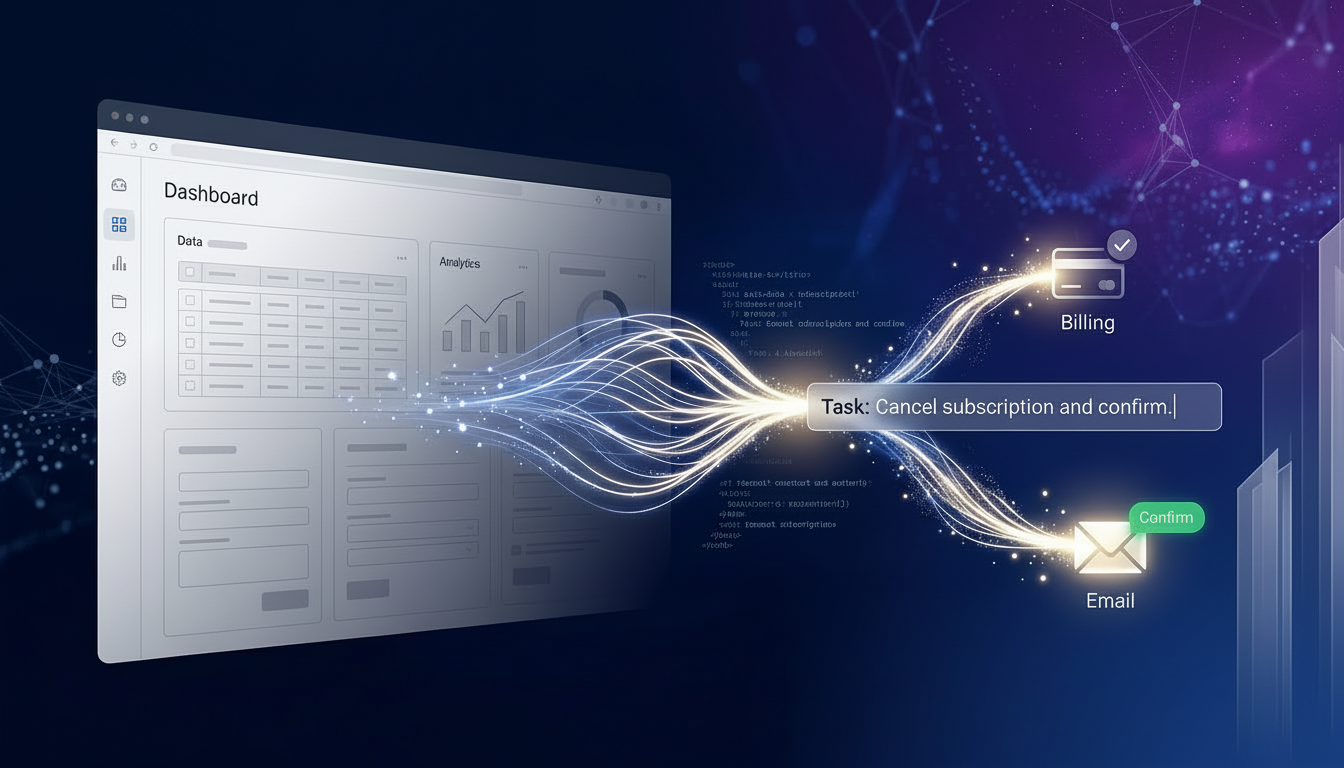
Imagine a user wants to cancel a subscription:
The Basic Bot: Responds with a 5-step guide on where to find the "Billing" tab. (User still has to do the work).
The AI Layer: Says "Done. I've canceled your plan and sent a confirmation email." (The work is finished).
That gap—between guiding and executing—is what defines a product that feels like a tool versus one that feels like a partner.
Customer support is usually seen as a cost center—a bottleneck that gets more expensive as you grow. AI flips the script. When your support is powered by an integrated AI layer:
Responses are instant: No "we’ll get back to you."
Scaling is infinite: You don’t need 50 more people to handle 50% more traffic.
Value is immediate: Support moves from "troubleshooting" to "problem-solving."
This is the "magic" moment. Agentic AI doesn’t just talk; it takes action. It’s deeply integrated into your backend, meaning it can actually do the chores your users hate.
Instead of a user navigating a complex UI, they give an instruction:
"Update my team's permissions." — Completed.
"Generate a quarterly report and Slack it to the board." — Delivered.
"Reschedule my Tuesday calls." — Handled.
The system stops being something the user operates and starts being something that works for them.
In the very near future, we won't judge software by how "intuitive" the UI is. We’ll judge it by how little we have to use the UI at all. Winning products will operate on three synchronized layers:
Chat: For natural interaction and instant clarity.
Automated Support: To resolve issues before they become tickets.
Agentic AI: To execute complex tasks with a single sentence.
The window for "experimental" AI is closing. Users are already gravitating toward products that value their time. The winners of this decade won’t be the companies that build the prettiest menus or the most talkative bots.
The winners will be the ones that do more with less effort from the user.
Is your product a tool users have to manage, or an engine that works for them?
Stay updated
Get our latest technical articles and product updates delivered to your inbox.