Beyond the Playground: Engineering the Shift to Systemic AI-Driven Development
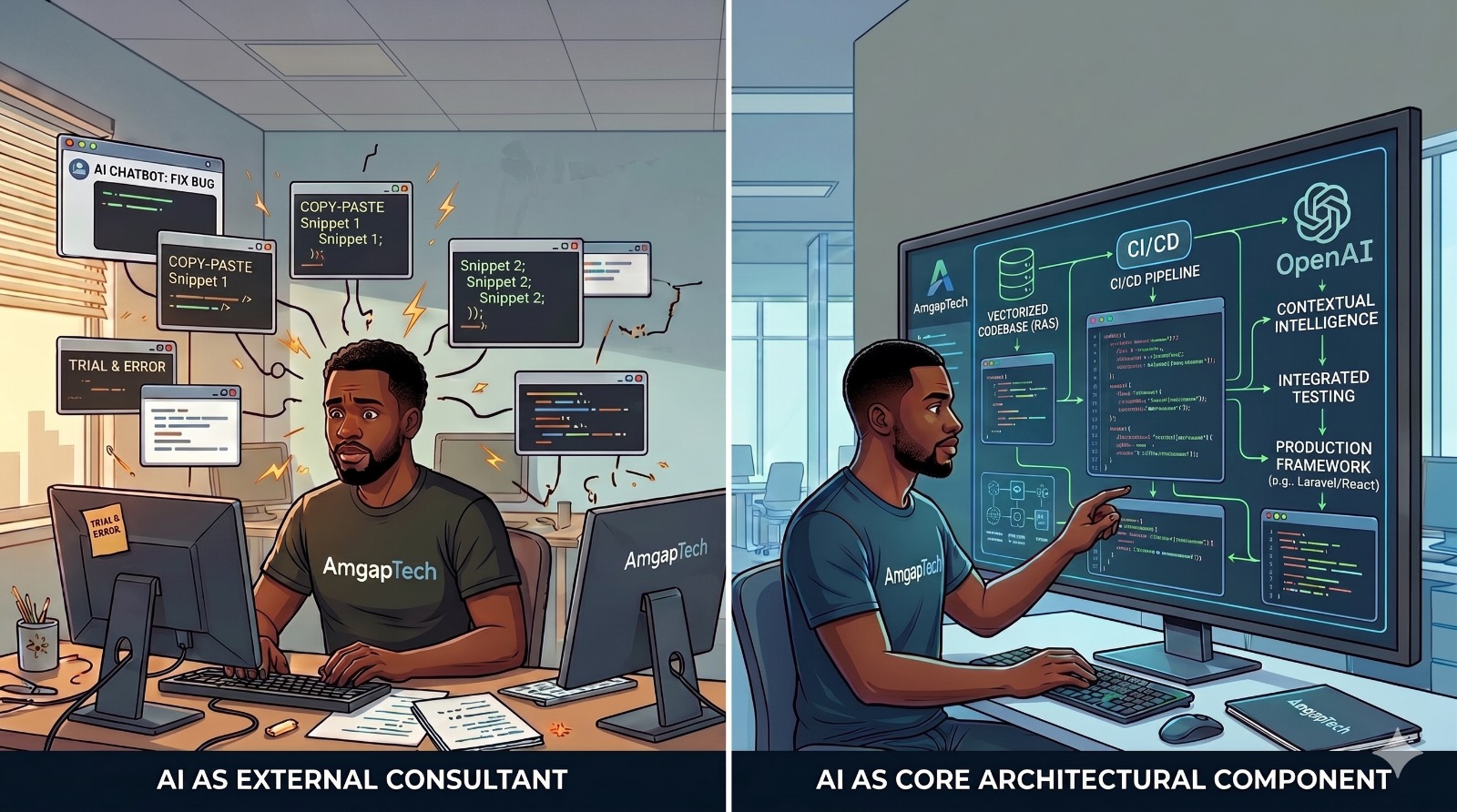
Most developers are stuck in a cycle of "AI tourism." We’ve all done it: you open a chat window, paste a buggy function, get a fix, and move on. It feels productive in the moment, but it’s fragmented. It’s a "playground" approach to building software.
The problem with this model is that it doesn’t scale. It doesn't help with system architecture, it doesn't understand your CI/CD pipeline, and it has zero context of your business logic. At AmgapTech, we’ve realized that to truly ship at the speed of thought, we have to move beyond these experimental hurdles. We need to stop using AI as an external consultant and start using it as a systemic development model.
The biggest hurdle in AI-driven development is the context gap. A standalone chatbot is only as smart as the 50 lines of code you just pasted into it. That's why "it works on my machine" has turned into "it works in the chat window but breaks the build."
Systemic development means integrating AI directly into the platform level. We’re moving toward a world where the AI has a "live" view of your entire repository, your database schema, and your API documentation. When the AI knows that changing the user_id type in your database migration will break three React components and a legacy reporting service, you’ve moved from "snippet generation" to "systemic orchestration."
In the early days of AI development, there were two extremes: the skeptics who refused to use it and the "copy-pasters" who trusted it blindly. Both are dangerous.
Systemic development requires a new kind of engineering culture. At AmgapTech, we treat AI-generated code exactly like code written by a junior developer: it doesn't exist until it passes a human review. * The AI proposes.
The platform validates (tests/linting).
The senior engineer audits.
By integrating AI into the workflow rather than just the "typing" phase, we turn it into a force multiplier instead of a liability.
Here is the technical trade-off: Building a systemic AI platform is significantly harder than just using an API. It requires:
Vectorizing your entire codebase for RAG-based context.
Fine-tuning models on your specific tech stack (like our Laravel/React/Docker environment).
Setting up rigorous automated testing to catch "hallucinated" logic before it hits production.
The "experimental" way is cheap and fast. The "systemic" way is expensive and slow to set up, but once it’s running, it allows a small team to out-build a massive enterprise.
There is a unique opportunity here. In regions where teams are often leaner and resources are more constrained, systemic AI isn't just a "nice to have"—it's a survival mechanism. It allows us to bypass the bloated "developer-heavy" models of the past.
By embracing integrated platforms over isolated tools, we can build digital infrastructure for Africa that is as robust as any global system but built with a fraction of the traditional overhead. We are moving from "trying to keep up" to "setting the standard."
AI is no longer an optional plugin; it is the new engine of software engineering. But an engine is useless if it isn't connected to the wheels.
At AmgapTech, we are focused on the "connection." We are building the bridges between raw AI power and finished, production-ready products. The transition from "experimenting" to "integrated" is where the real value is created.
Are you still playing in the sandbox, or are you building the factory?
Sources
Stay updated
Get our latest technical articles and product updates delivered to your inbox.