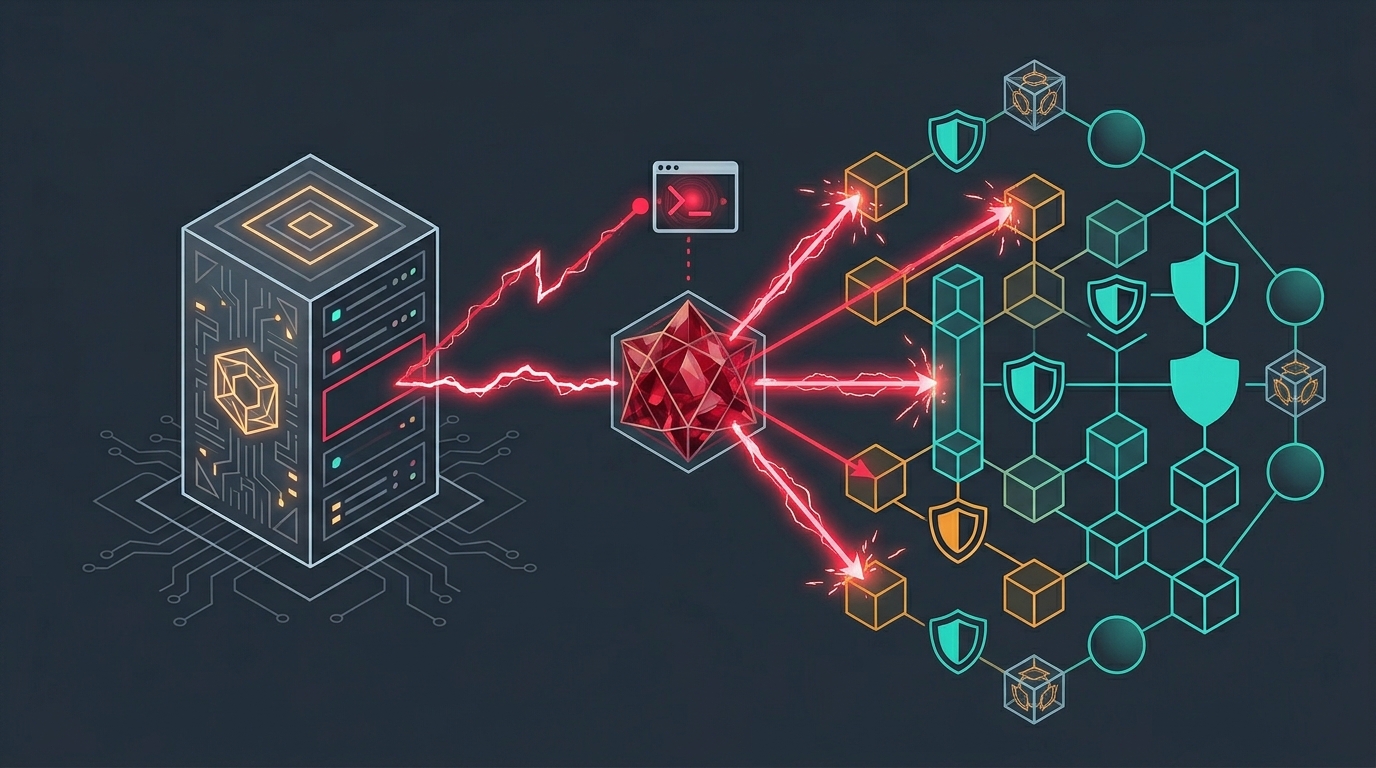
The 4-Hour Window: PraisonAI and the Looming Threat of Rapid Agent Exploitation
For years, application security teams measured patch deployment windows in days or weeks. If a security advisory was published on a Monday, you generally assumed you had a short grace period to build, test, and push an update through your CI/CD pipeline.
The disclosure of CVE-2026-44338 in PraisonAI—an open-source multi-agent orchestration framework—has officially shattered that risk model. On May 11, 2026, at exactly 13:56 UTC, a GitHub advisory revealed a critical authentication bypass flaw.
By 17:40 UTC—just 3 hours and 44 minutes later—malicious scanners were already hitting live internet-exposed instances, probing the exact vulnerable endpoint.
This is no longer an outlier. The window between public vulnerability disclosure and live network exploitation has shrunk to single-digit hours.
PraisonAI is designed to orchestrate autonomous AI agents across enterprise workflows, connecting local scripts to model APIs and execution tools. The vulnerability, carrying a CVSS score of 7.3, exposes a fundamental architectural oversight: shipping with insecure defaults.
The project bundled a legacy Flask API server (src/praisonai/api_server.py) that hard-coded initialization settings to AUTH_ENABLED = False and AUTH_TOKEN = None. When developers deployed this containerized framework to an internet-facing host without setting up an explicit reverse proxy or external gateway, they published the complete control plane to the open web:
[Unauthenticated Attacker]
           │
           ▼ (Sends GET /agents)
[Legacy API Server (AUTH_ENABLED = False)]
           │
           ▼ (Returns 200 OK)
Exposes agent_file, model paths, and tool signatures
Because the internal authorization helper function simply evaluated whether authentication was disabled globally, the system failed open by design. Any remote caller could unrestrictedly query /agents to enumerate the entire workspace configuration.
Even worse, the unauthenticated /chat endpoint stood completely open, ready to accept any arbitrary JSON payload and execute the primary agents.yaml workflow on the host machine.
Telemetry published by Sysdig’s Threat Research Team highlights how industrial-scale scanning tools immediately weaponize these advisories. The threat activity observed originated from a DigitalOcean IP address (146.190.133.49) using a structured, automated scanning profile:
The Initial Sweep: The bot execution loop launched a broad automated scan targeting generic configuration leaks, looking for file strings like
/.env,/admin,/Gemfile.lock, and configuration management paths.The AI Pivot: Exactly eight minutes later, the scanner narrowed its signature exclusively to AI framework surfaces. It explicitly hit
/praisonai/version.txtand fired a single unauthenticatedGET /agentsrequest carrying the user-agent stringCVE-Detector/1.0.The Exploitation Check: The server immediately returned a
200 OKstatus code alongside a full JSON response body revealing the internal agent list and the file pathagents.yaml.
While this specific scanner did not proceed to send destructive POST requests to /chat, the footprint was verified. The host was logged as an open, vulnerable target for immediate exploitation or downstream data theft.
The true severity of a PraisonAI-class breach isn't arbitrary code execution inside the API runner itself—it is the Agent Execution Context. In production environments, enterprise agents are not sandboxed conversational text bots; they are integrated system actors.
When an unauthenticated request triggers a workflow via /chat, it executes the full graph of tools wired up in agents.yaml. These tools commonly include local Python code interpreters, host shell executors, file system read/write utilities, and web fetch tools.
An attacker invoking an open agent control plane inherits the complete permissions model of that workspace. They can silently command the deployed agents to exfiltrate internal CRM databases, scour company ticketing systems, read sensitive corporate wikis, or manipulate connected cloud APIs.
Furthermore, because these agents call frontier cloud services under the hood, a rogue loop running unauthenticated requests will completely exhaust an organization's API rate limits and pile up massive, unexpected model provider bills within a few hours.
The rapid automation of adversary tooling means project scale no longer provides security through obscurity. If you are running orchestration frameworks like PraisonAI, CrewAI, Langflow, or AutoGen, you must treat your agent environments with the identical security discipline applied to a core production database.
If you have a live deployment, executing these remediation steps is an immediate priority:
Enforce Framework Patches: Immediately migrate to PraisonAI version
4.6.34or higher. This update completely deprecates the legacy, unauthenticated server configurations and automatically mandates authentication checks across all active endpoints.Isolate the Control Plane: Never expose your agent API runtime ports (such as
:8080) to the public internet. Bind your orchestration frameworks explicitly to your local loopback address (127.0.0.1) or place them inside an isolated, private virtual network.Rotate Framework Secrets: Because an open instance compromises the configuration layer, you must immediately cycle any API keys, database strings, or third-party cloud tokens referenced anywhere within your
agents.yamlor.envfiles.Monitor API Billing Anomalies: Review your model provider subscription dashboards (OpenAI, Anthropic, AWS Bedrock) for any sharp spike in token usage or unrecognized prompt trails originating on or after May 11, 2026.
The PraisonAI exploit timeline proves that the security architecture of AI frameworks has not kept pace with their adoption rate. Attacker tooling has fully caught up to the generative era, using AI capability to automatically parse code updates and launch global scanning infrastructure within minutes of a bug landing on GitHub.
At AmgapTech, our stance on infrastructure security is absolute: convenience parameters that fail open by default are an unacceptable production liability. As agent frameworks evolve into critical enterprise infrastructure, treat every endpoint as untrusted and secure your runtime environments before the automated scanners do it for you.
Is your agent framework running securely behind a zero-trust perimeter, or is your entire corporate data plane an unauthenticated request away?
Sources
Stay updated
Get our latest technical articles and product updates delivered to your inbox.